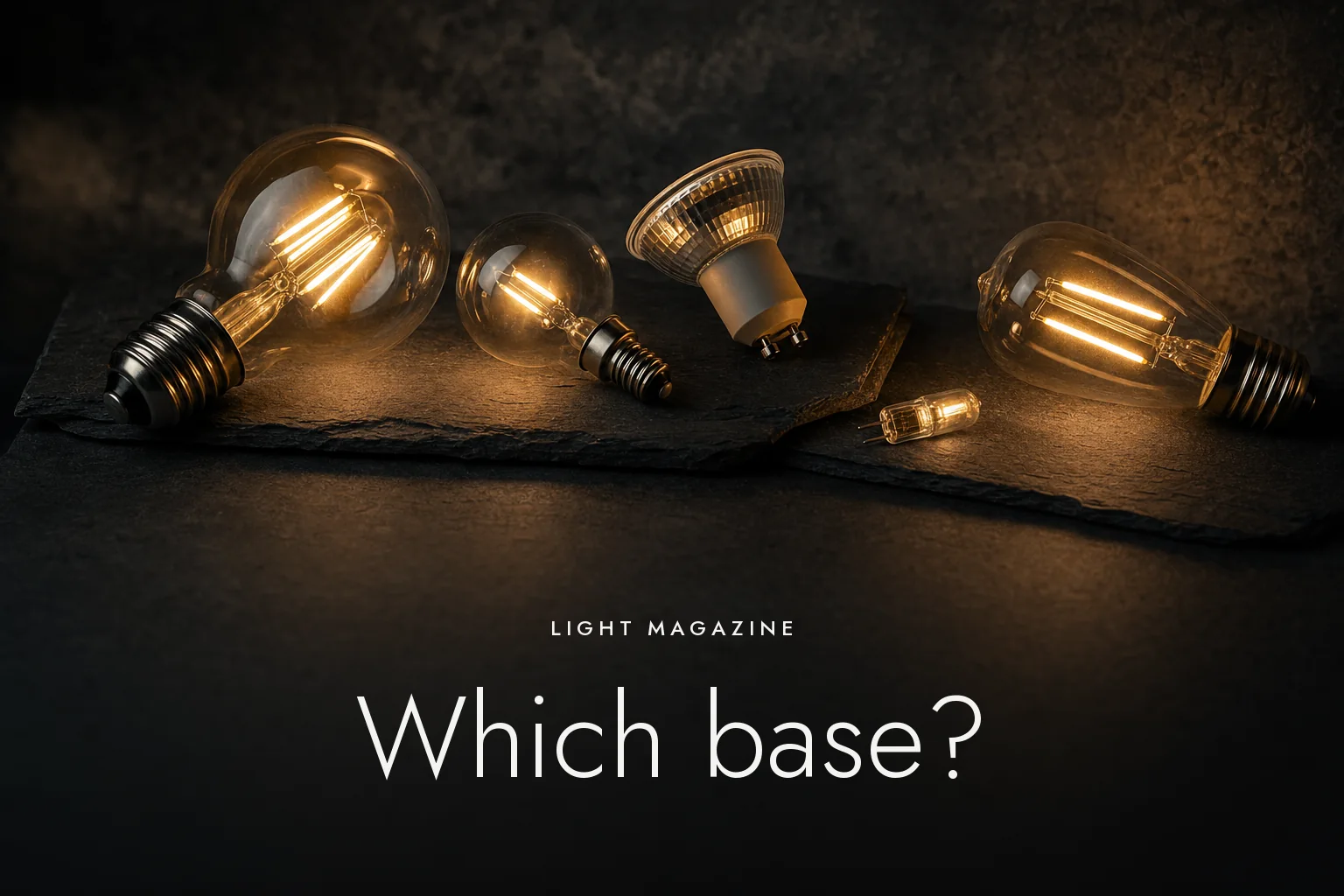
The base is where the lamp and the light source meet — and where most wrong purchases happen. The markings are logical; it’s just that nobody explains them: the letter gives the type of base, the number its size in millimetres. So an E27 is an Edison screw base 27 millimetres in diameter.
This article goes through the six types you will find in most European homes, shows which ones need a transformer, and tells you how to work out, without any tools, what is in your own lamp.
What is the most common bulb base?
In most homes in continental Europe it is the E27: a screw base 27 millimetres in diameter that runs on 230-volt mains voltage, without a transformer. It is found in most ceiling lights and floor lamps. The second most common is the E14 — the same thread at 14 millimetres, typically in chandeliers and candle bulbs.
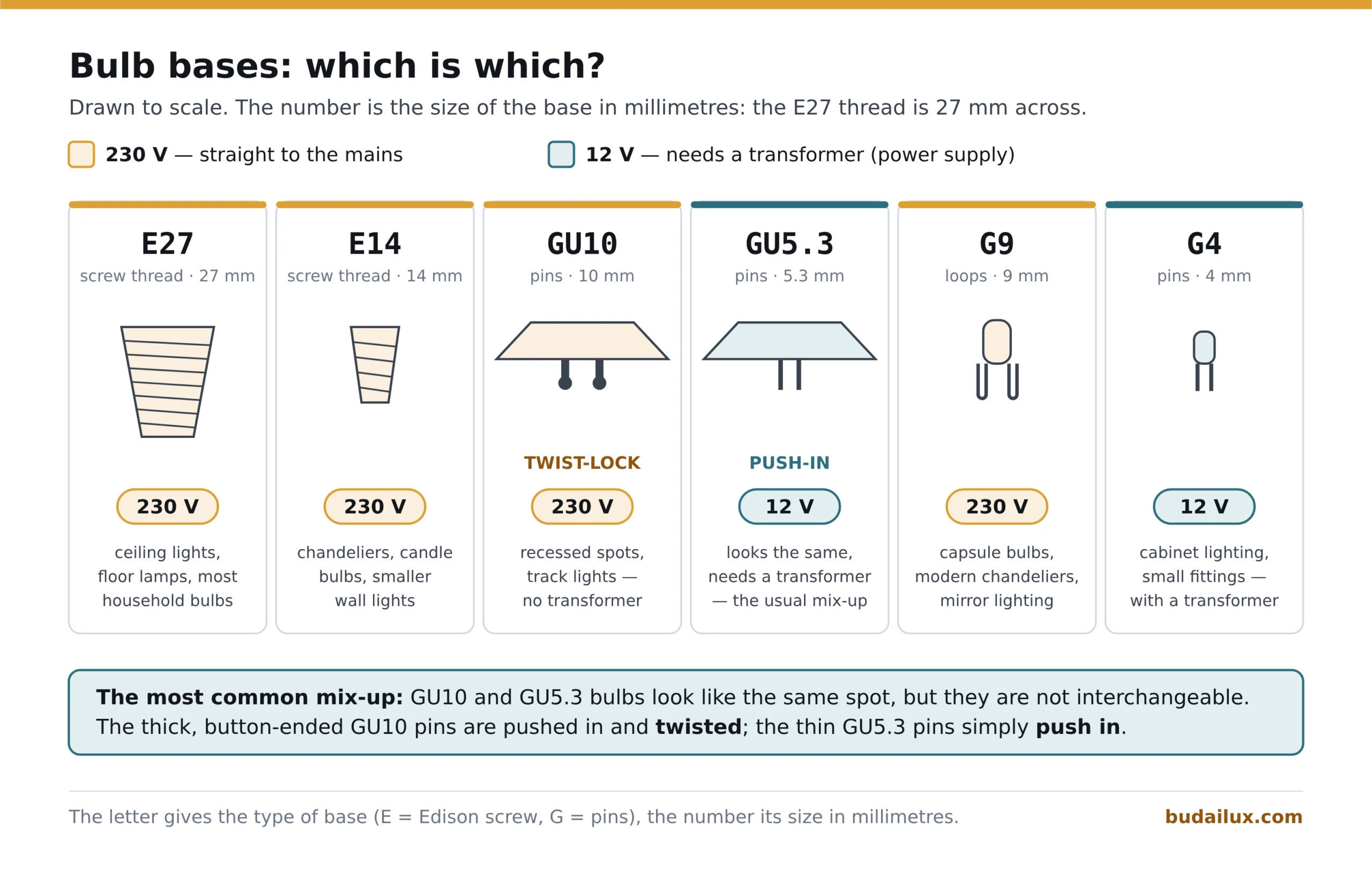
The six types in one table
| Marking | Base | Size | Voltage | Where you’ll find it |
|---|---|---|---|---|
| E27 | screw thread | 27 mm | 230 V | ceiling lights, floor lamps, most household bulbs |
| E14 | screw thread | 14 mm | 230 V | chandeliers, candle bulbs, wall lights, fridges |
| GU10 | pins, twist-lock | 10 mm | 230 V | recessed spotlights, track lights |
| GU5.3 | pins, push-in | 5.3 mm | 12 V | the same kind of spotlight, but with a transformer |
| G9 | loops | 9 mm | 230 V | capsule bulbs, modern chandeliers, mirror lighting |
| G4 | pins | 4 mm | 12 V | furniture lighting, small built-in lights |
What is the difference between E27 and E14?
Only the size: the E27 thread is 27 millimetres in diameter, the E14 thread 14. Both are screw bases and both run on 230 volts, but they are not interchangeable. There are adapters that let an E14 lamp holder take an E27 bulb, but the light fitting’s design and heat dissipation may not cope with the larger bulb — so only use one if the lamp’s manufacturer allows it.
An easy way to tell them apart from memory: the E27 thread is roughly the diameter of a €2 coin (25.75 mm), and the E14 is about half that. If in doubt, measure the inside diameter of the lamp holder — the number is roughly what you get.
What is the difference between GU10 and GU5.3?
The GU10 runs on 230 volts and connects straight to the mains; its pins are thick with button ends — you push it in and twist. The GU5.3 runs on 12 volts and needs a transformer; its pins are thin and straight — you just push it in. From the outside, both bulbs look like the same spotlight, but they are not interchangeable.
This is the most common mix-up in a lighting shop, and given how annoying it is, it’s worth remembering: a GU5.3 bulb won’t even physically fit into a GU10 lamp holder. The pin spacing is 10 versus 5.3 millimetres — you can see the difference by eye if you put them side by side.
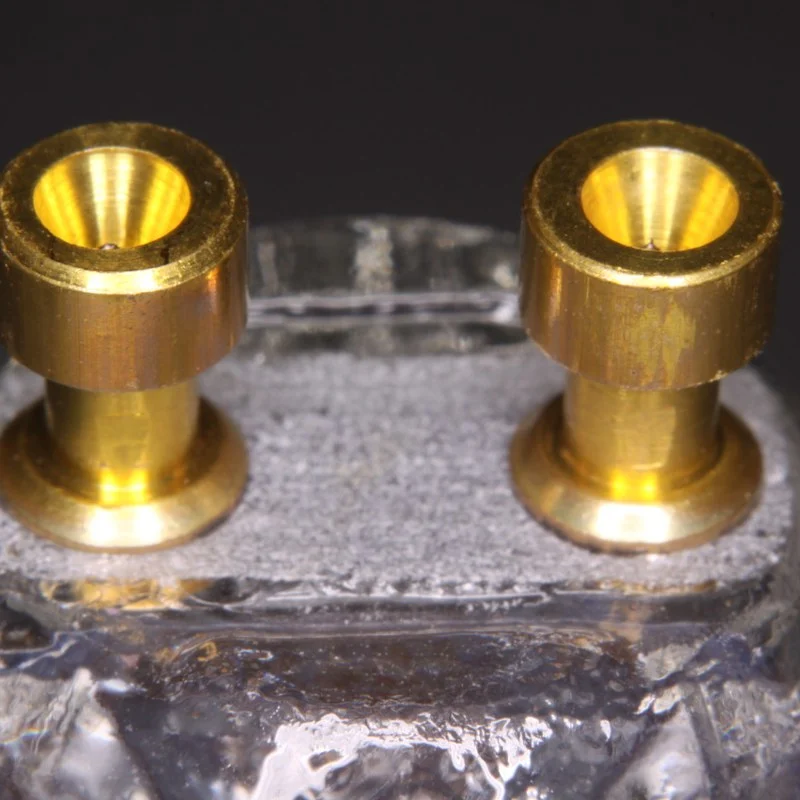
Photo: Pascal / Wikimedia Commons · CC0
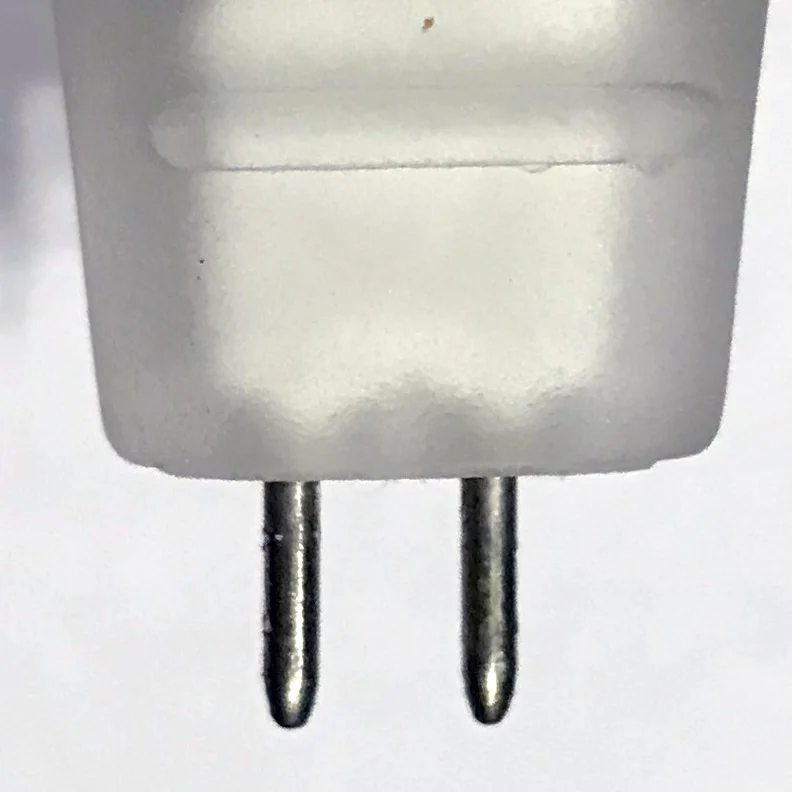
Photo: Sandstein / Wikimedia Commons · CC BY-SA 4.0
The practical consequence matters more than the naming. If you have a GU5.3 system, there is a transformer somewhere in the ceiling or the furniture. When you switch to LED, this transformer causes most of the problems: older electronic transformers designed for halogen need a minimum load (the lower end of the power range on the rating plate, for example 20 W on a 20–70 W transformer), which an LED of a few watts doesn’t reach. The LED then flickers, buzzes or doesn’t light at all. The fix is not a different bulb but a power supply designed for LEDs.
Which bases need a transformer?
The 12-volt bases need a transformer: GU5.3 (the base of MR16 spotlights) and G4. The E27, E14, GU10 and G9 connect straight to the 230-volt mains and need nothing else.
Note that the G9 and the G4 look similar — both are small and capsule-shaped — but the G9 runs on 230 volts and the G4 on 12 volts. Mix them up and the 12-volt bulb will fail instantly on mains voltage. The G9’s pins are loops and the G4’s are straight: you can see it as soon as you pick one up.
How do I find out what’s in my lamp?
Switch off the power first, then follow three steps:
- Look at the base of the old bulb. The marking is usually printed on the metal or the ceramic: “E27”, “GU10”, “G9”. This is the most reliable way.
- If it isn’t legible, measure. For a screw base, the outside diameter of the thread gives the number: 27 mm → E27, 14 mm → E14. For pins, measure the distance between the centres of the two pins: 10 mm → GU10, 5.3 mm → GU5.3, 4 mm → G4.
- Check the rating plate of the light fitting. It shows the base type and the maximum wattage. With LEDs the latter is rarely a limit, but on older lamps it should be taken seriously because of heat dissipation.
If you’re not sure, ask. Take a photo of the old bulb and the lamp holder, send it to info@budailux.hu, and we’ll tell you which one you need. Five minutes spent identifying it costs less than buying the wrong bulb.
Frequently asked questions
What does the E27 marking mean?
The E stands for the Edison screw thread, and 27 is the diameter of the thread in millimetres. The E27 is the most widespread household base in continental Europe; it runs on 230-volt mains voltage, without a transformer.
Can I put an E14 bulb in an E27 lamp holder?
Not directly, because the thread is half the size. An adapter can do it, but the fitting’s shade and heat dissipation were designed for the original bulb, so only use an adapter if the lamp’s manufacturer allows it.
How do I know whether I need GU10 or GU5.3?
Take out the old bulb and look at the pins. If they are thick with button ends, and you had to twist the bulb to remove it, it’s a GU10. If they are thin and straight, and the bulb simply pulls out, it’s a GU5.3 — and then there is a transformer in the system too.
Why does the LED in my spotlight flicker?
The most common reason is that the 12-volt system has an electronic transformer designed for halogen, which needs a minimum load. An LED of a few watts doesn’t reach it, so the transformer doesn’t work reliably. The fix is an LED-compatible power supply, not a different bulb.
Are G9 and G4 the same?
No, and swapping them is dangerous. The G9 runs on 230 volts and has looped pins; the G4 runs on 12 volts, has straight pins and needs a transformer. A 12-volt bulb fails instantly on mains voltage.
If you also need to decide how much light you need, the lumen guide gives you a number; if you are choosing an outdoor or bathroom light, the article on IP ratings is the next step.
Sources
- IEC 60061-1 — Lamp caps and holders together with gauges for the control of interchangeability and safety, Part 1: Lamp caps — the international standard for the dimension sheets of lamp caps (E27, E14, GU10, GU5.3, G9, G4); its European reference is EN 60061-1.
- Philips (Signify): Professional LEDlamps LV range — recommended transformer compatibility list — gives, for each electronic halogen transformer, how many 12 V LED spots can be connected to it, and generally marks iron-core transformers as compatible.
- European Central Bank: Common sides of the euro coins — the €2 coin has a diameter of 25.75 mm.