
An old incandescent bulb could be dimmed with almost any dimmer. With LEDs it isn’t that simple: the same dimmer will smoothly dim one LED, while with another it flickers, buzzes or glows faintly even when switched off. The fault rarely lies in the LED or the dimmer on its own — far more often it lies in the pairing of the two.
Below we go through what the “dimmable” marking means, how leading-edge and trailing-edge dimmers differ, why the minimum load matters, and what the EU requires on LED flicker. The troubleshooting table collects the most common causes of buzzing and flickering.
What does the “dimmable” marking mean?
You can reduce the brightness of a dimmable light source with a dimmer. A non-dimmable LED on a dimmer may flicker, buzz or fail. In the EU, the box has to say if the light source is not dimmable, or only works with certain dimmers; the compatible dimmers have to be listed on the manufacturer’s website.
The rule comes from the Ecodesign Regulation (EU) 2019/2020: the packaging must carry a warning if the light source cannot be dimmed, or can be dimmed only with specific types of dimmer or dimming methods; in the latter case, the compatible dimmers have to be listed on the manufacturer’s website. In the EU’s EPREL database, which the QR code on the energy label leads to, the “Dimmable” field can take three values: yes, only with specific dimmers, no.
So “dimmable” doesn’t mean it works with any dimmer. According to Philips Dynalite’s guide to LED dimming, only lamps specifically designed by their manufacturer to be dimmable can be dimmed, while a non-dimmable lamp or an unsuitable dimming method can cause undesirable behaviour, up to complete failure of the lamp.
The other mandatory details on the box are covered in our article on what lumens, lux, watts and kelvin mean, and the EU conformity of lights in our guide to CE marking.
What is the difference between leading-edge and trailing-edge dimmers?
Conventional wall dimmers work on the phase-cut principle: they cut a slice out of every half-wave of the 230 V, 50 Hz mains voltage, so the lamp receives less energy. Which end of the half-wave is cut off defines two separate types.
- Leading-edge dimmer: cuts off the start of the half-wave and only switches on at the set moment. Typically TRIAC-based, an older type, made for incandescent bulbs, halogen and iron-core transformers.
- Trailing-edge dimmer: switches on at the start of the half-wave and cuts off the end. It is a better match for electronic loads, such as electronic transformers and LED drivers.
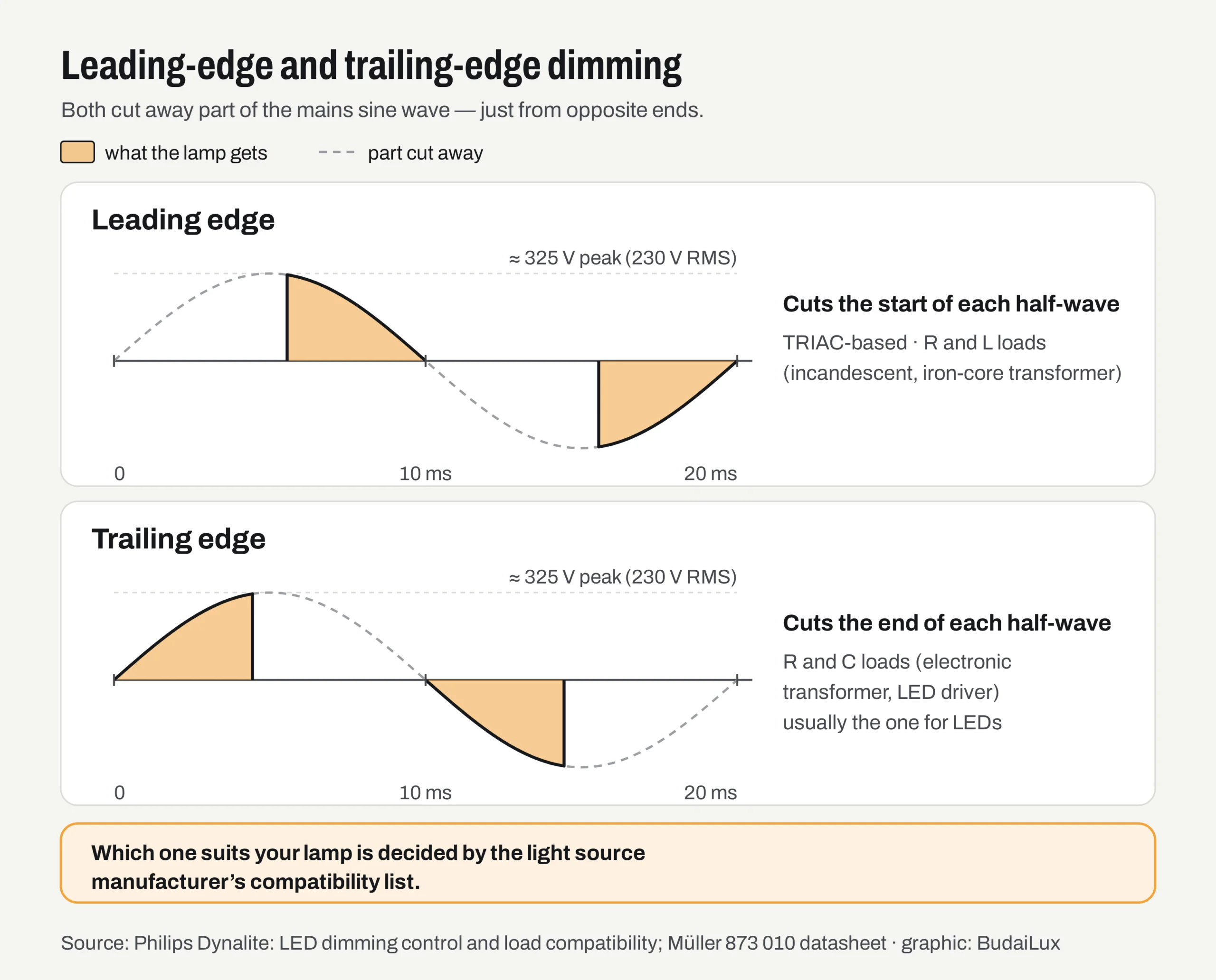
Letters on the back of the dimmer or in its datasheet show which loads it is for: R = resistive (incandescent, 230 V halogen), L = inductive (iron-core transformer), C = capacitive (electronic transformer, LED driver). According to the manufacturer’s datasheet for one universal dimmer, an R load can be dimmed with either leading-edge or trailing-edge control, an L load only with leading-edge and a C load only with trailing-edge. Some universal (RLC) dimmers detect the type of load themselves.
For LEDs, a trailing-edge dimmer is usually the better choice. According to MK Electric’s guide to its dimmers, the components of TRIAC-based leading-edge dimmers can cause unwanted buzzing, and most of today’s LED lamps are designed for trailing-edge dimmers. There is no hard and fast rule, though: according to Signify’s recommended dimmer list, Philips dimmable LED light sources can generally be dimmed with any type of dimmer (R, RL, RC or RLC). So in the end, it is always the light source manufacturer’s compatibility list that decides.
How do you choose a dimmer for LEDs?
Before you buy a new dimmer switch, or use your old one with LED bulbs, check five things:
- Check the light source’s box. If it says “not dimmable”, don’t put it on a dimmer. If it says “only with certain dimmers”, find the manufacturer’s list.
- Find the dimmer on the list. Signify’s list, for example, gives for each type of dimmer how many lamps it was tested with, over what range they dim, and whether they glow when switched off. The list was compiled in a laboratory at nominal mains voltage; a different voltage can give a different dimming range.
- Read the dimmer’s specifications: the letter code (R, L, C or “LED”) and the power range, for example 3–100 W. The LED dimmers on Signify’s list have a lower limit of a few watts; older dimmers designed for incandescent bulbs often 20–60 W.
- Check whether a neutral wire is needed. There are two-wire and three-wire dimmers. For the wired Philips Hue wall dimmer module, the manufacturer states that it also works without a neutral wire, but then the light is less bright and some LED bulbs may not work properly.
- Don’t put smart bulbs behind a conventional dimmer. Smart bulbs are dimmed by the app or their own controller; for this, manufacturers offer wall modules that don’t cut the power to the light source.
Why do a dimmer’s minimum and maximum loads matter?
Because a dimmer only works reliably within its stated power range. If the total wattage of the LEDs connected to it is below the minimum, the light flickers, doesn’t switch on properly, or glows even when switched off. According to Philips Dynalite’s guide, with leading-edge dimmers the LEDs don’t draw enough current for correct operation, which can cause constant flickering.
An example: three 5 W LED bulbs, 15 W in total, on an old 20–400 W dimmer. That is below the minimum — a single 60-watt incandescent bulb used to be more than enough, but LEDs need only a fraction of that for the same light. The same three lamps sit comfortably within the range of a 3–100 W LED dimmer.
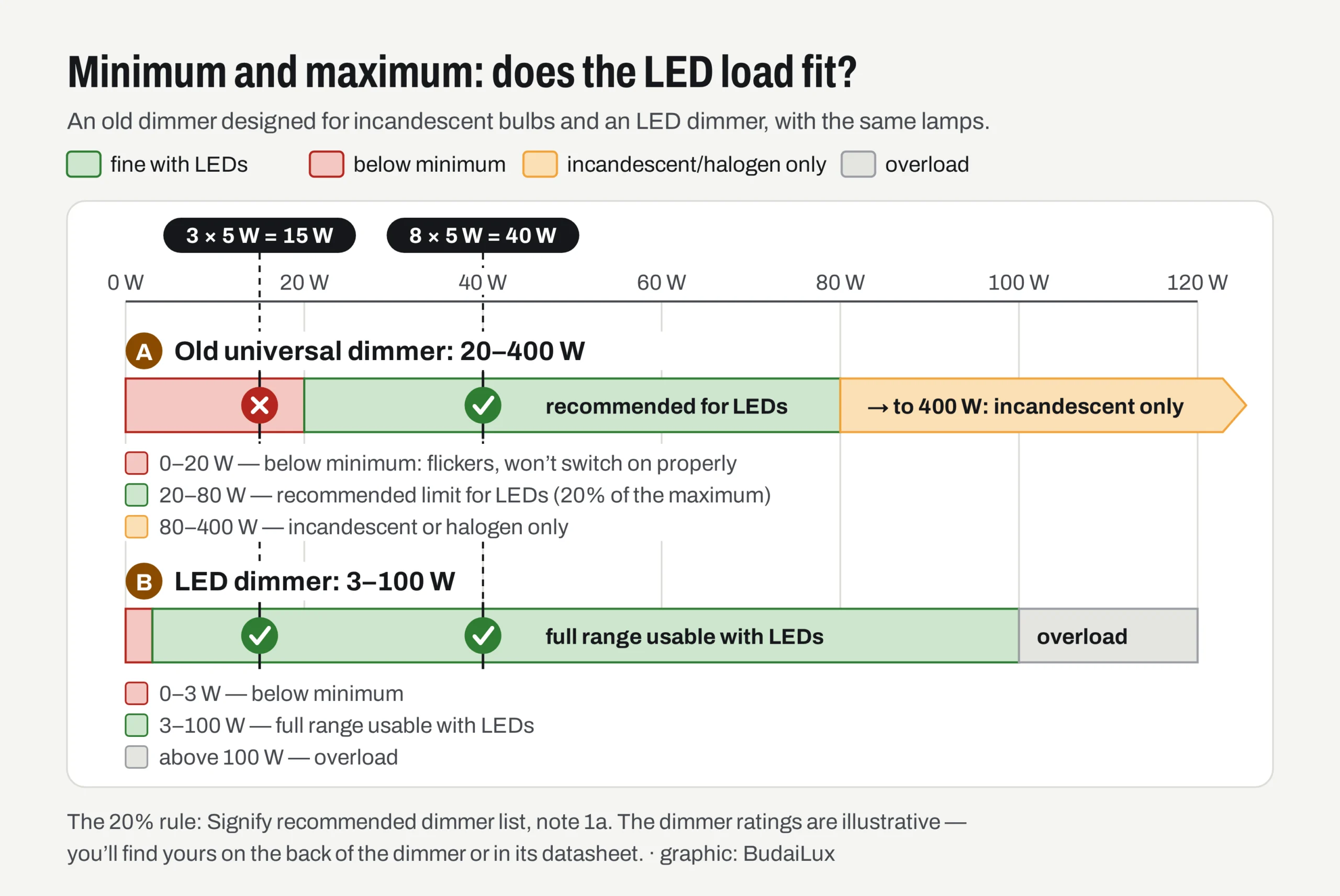
Be careful at the upper limit too. According to Signify, most dimmers not made specifically for LEDs can take LEDs up to only 20% of their stated maximum: no more than 80 W on a 400 W dimmer, for example sixteen 5 W LED bulbs. LED dimmers can be loaded up to their stated maximum. MK Electric also points out that because of the inrush current of LEDs, some dimmers have a limit on the number of lamps.
If the load is too low, there are three solutions: more light sources on the same circuit, an LED dimmer with a lower minimum, or what is called a compensator (active load), which several dimmer manufacturers offer for this purpose.
Why does an LED buzz or flicker on a dimmer?
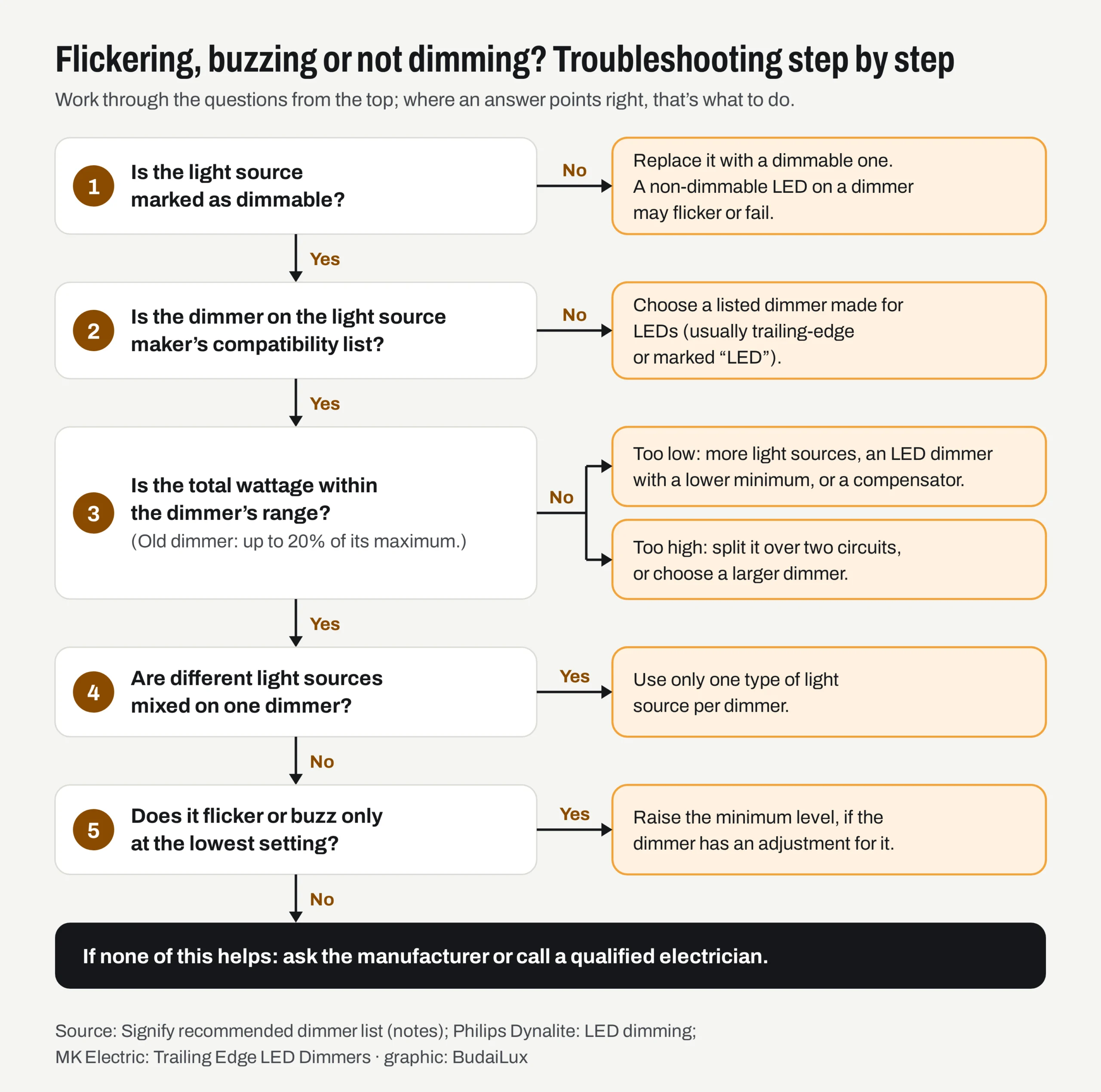
The most common causes are a non-dimmable light source, an incompatible dimmer and a load outside the dimmer’s range. The flow chart below shows the order in which to troubleshoot, and the table the symptoms.
| Symptom | Likely cause | What to do |
|---|---|---|
| Flickers or shimmers at every setting | Non-dimmable light source, or an incompatible dimmer | A dimmable light source and a dimmer on the manufacturer’s list |
| Flickers only at low brightness, or suddenly goes out there | The light source can’t cope with deep dimming | Raise the dimmer’s minimum level, if it has an adjustment for it |
| The dimmer or the lamp buzzes | Leading-edge (TRIAC) dimmer with LEDs | A trailing-edge dimmer or one made for LEDs |
| Glows faintly even when switched off | Too few light sources on the dimmer, especially with a dimmer that has no neutral wire | More lamps on the circuit, a compensator, or a dimmer that uses a neutral wire |
| Doesn’t start when switched on, or the dimmer cuts out | Too many LEDs: inrush current, overload | Fewer lamps per circuit, or a larger LED dimmer |
| Nothing happens at the start of the turn, then the light jumps | The LED only starts above a certain level; with some lamps this can be 10–15% | Set the minimum level on the dimmer |
| One lamp flickers, the other doesn’t | Mixed light sources on one dimmer | Only one type of light source per dimmer |
According to Signify’s list, even a well-matched dimmer and LED can show slight flicker at one particular setting. If it appears at only one point and the light is steady over the rest of the range, it is not a fault.
What does the EU require on LED flicker?
Since 1 September 2021, mains LED light sources have had to meet two flicker limits, measured at full brightness: for visible flicker Pst LM ≤ 1.0, and for the stroboscopic effect SVM ≤ 0.9, which was replaced by SVM ≤ 0.4 from 1 September 2024. Both are in Table 4 of Annex II to Regulation (EU) 2019/2020.
| Parameter | What does it measure? | Limit | Since |
|---|---|---|---|
| Pst LM | Visible flicker for a stationary observer in a stationary environment. 1.0 means an average observer has a 50% chance of noticing it. | ≤ 1.0 | 1 September 2021 |
| SVM | Stroboscopic effect: moving objects look “jerky”. 1.0 is the visibility threshold. | ≤ 0.9 | 1 September 2021 |
| SVM | the same, with a stricter limit | ≤ 0.4 | 1 September 2024 |
Two important limitations: the limits apply at full brightness — the regulation sets no flicker limit for the dimmed state. And they only apply to mains light sources, running directly on 230 V, not to 12 or 24 V LED strips and spotlights. Among the points for the regulation’s review, the Commission itself lists stricter flicker requirements and rules on dimming.
The actual values are on the product’s EPREL record, and many manufacturers also give them in their datasheets: for one Signify LED bulb, for example, Pst LM 1 and SVM 0.4.
What are 0–10 V, DALI and smart control for?
Not all dimming happens on the 230 V wiring. In light fittings and LED strips, the driver (LED power supply) can also accept a separate control signal:
- 0–10 V (1–10 V): an analogue signal on two separate control wires. Simple and one-way: the controller sets the level, and there is no feedback.
- DALI: digital, two-way control, defined by the IEC 62386 series of international standards. The signal runs on one pair of wires, polarity doesn’t matter, and the lights can be addressed individually and can even report their faults (DALI Alliance).
- PWM or resistance: some LED power supplies accept these too. According to Mean Well’s installation guide, its power supplies with “3 in 1” dimming can be controlled with 0/1–10 V, a 10 V PWM signal or a resistance.
- Smart (app) control: over Wi-Fi, Zigbee or Bluetooth, the bulb or the driver does the dimming itself; this needs a constant power supply.
In every case, the driver and the controller must support the same method. Switching and dimming options for LED strips under kitchen cabinets are covered in our article on worktop lighting.
Safety note. Replacing a wall dimmer means working on 230 V mains wiring, so we recommend having it done by a qualified electrician; national rules may also limit who is allowed to carry out electrical work in the home. Before starting, the circuit breaker must be switched off and a two-pole voltage tester used to confirm that the wires are dead — a screwdriver-type voltage tester is not reliable for this. Wire colours and the testing steps are covered in our article on live, neutral and earth, and wiring switches in our guide to wiring a ceiling light or chandelier. If it isn’t clear which wire is which in the back box, or the dimmer needs a neutral wire and there isn’t one, leave it to a qualified electrician.
Frequently asked questions
What happens if I put a non-dimmable LED on a dimmer?
It may flicker, buzz or eventually fail, whatever the dimmer setting. The safe solution is a dimmable LED bulb, or an ordinary switch instead of the dimmer.
Does every dimmable LED work with every dimmer?
No. The dimmable marking only tells you that the light source can be dimmed; which dimmer it works with is given in the manufacturer’s compatibility list. For each type of dimmer, the list also gives the number of lamps and the dimming range.
Why does the LED glow when the dimmer is switched off?
Because a small current still passes through the dimmer when it is off, and that is enough to make an LED glow faintly. According to Signify, this mainly happens when there are few light sources on the dimmer. More lamps on the circuit, a compensator or a dimmer that uses a neutral wire can help.
Do I need a new dimmer when switching from incandescent bulbs to LEDs?
Often, yes. LEDs easily fall short of the minimum load of old dimmers (often 20–60 W), and leading-edge types may buzz. If your old dimmer is on the LED light source manufacturer’s list and the load is within its range, it can stay.
Sources
- Commission Regulation (EU) 2019/2020 on ecodesign requirements for light sources, consolidated version (1 September 2021), EUR-Lex — Annex I, points 50–51: flicker and stroboscopic effect; Annex II, Table 4: Pst LM and SVM; Annex II, point 3(b)(l): the dimmability warning; Article 9: review.
- Signify (Philips): Recommended dimmer compatibility list for Mains Voltage Lamps (PDF) — the 20% load rule, glowing when switched off and mixed loads, in the notes.
- Philips Dynalite: LED Dimming control and load compatibility (PDF) — leading-edge and trailing-edge control, the causes of LED flicker.
- MK Electric (Honeywell): Trailing Edge LED Dimmers (PDF) — buzzing from TRIAC dimmers, inrush current, start-up level.
- Müller: datasheet for the 873 010 rlc and 873 030 led flush-mounted dimmers (PDF) — which dimming mode goes with R, L and C loads.
- DALI Alliance: Introducing DALI — the DALI protocol and the IEC 62386 series of standards.