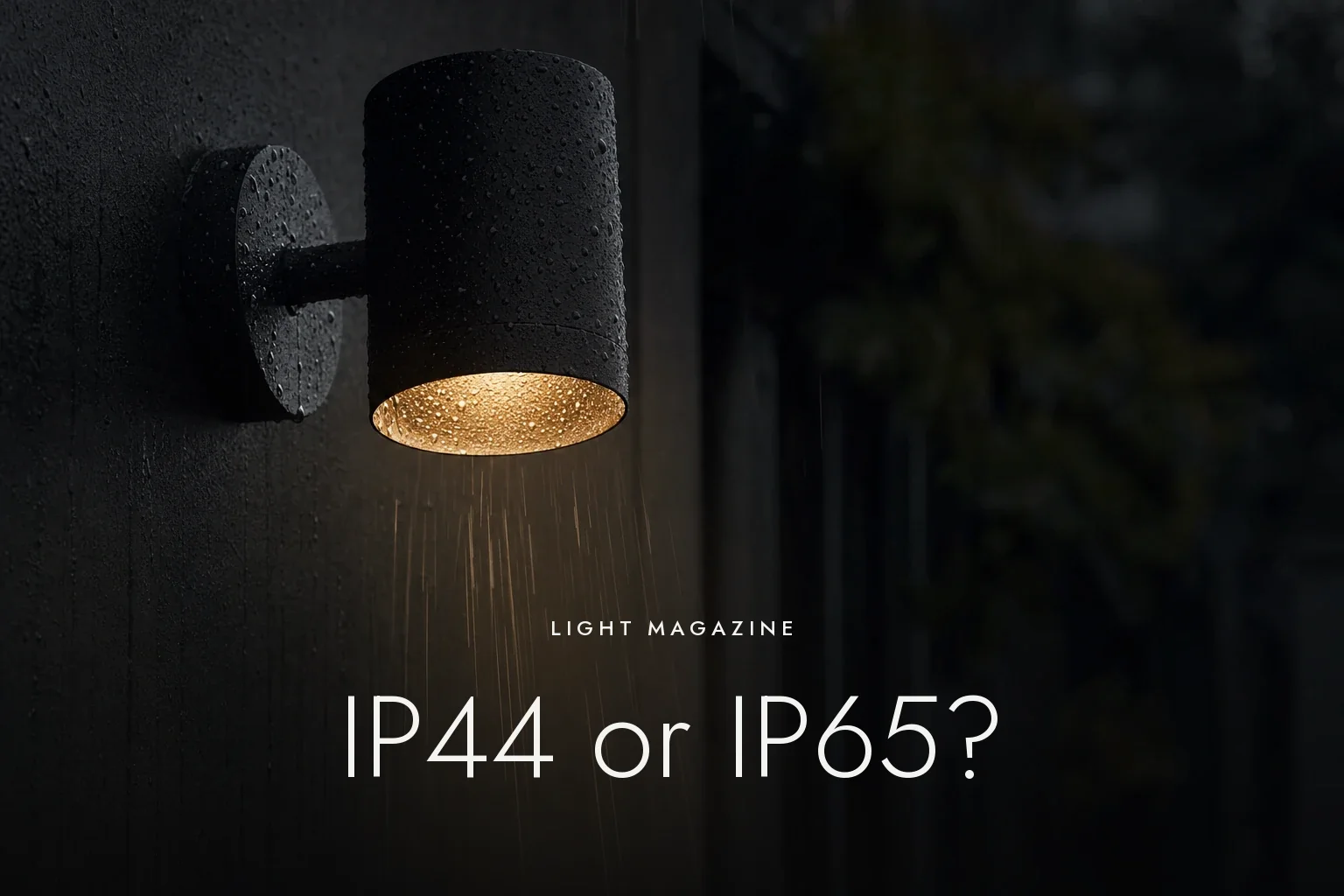
The IP rating on the box is one of the most important figures for a light, and most people misread it. It isn’t a single scale where a higher number is always better: two separate digits measure two separate things. One tells you what size of solid object is kept out, the other what kind of water exposure the light can withstand.
This article gives you both scales, shows which rating you need outdoors and in a bathroom, and — the more important part — explains what the IP rating doesn’t tell you. When an outdoor light fails within two years, the IP rating is usually not to blame.
What does IP44 mean?
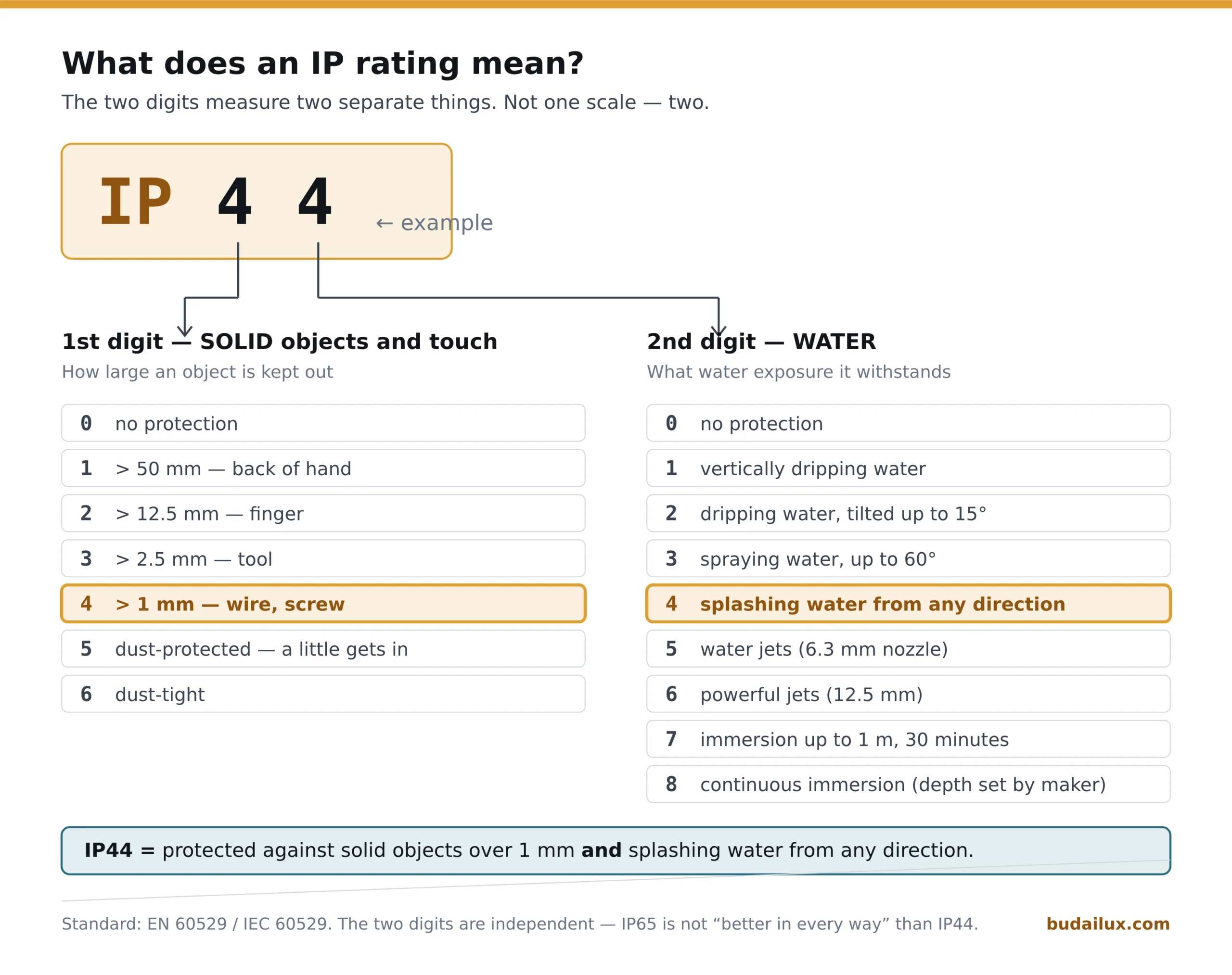
IP44 means the light is protected against solid objects larger than 1 millimetre (wire, screws, insects) and against water splashing from any direction. It is suitable for covered outdoor areas and bathrooms, but it does not withstand water jets, pressure washing or immersion.
What do the two digits mean?
IP stands for International Protection (often called Ingress Protection); the classification comes from the IEC 60529 standard, published in Europe as EN 60529. The first digit indicates protection against solid objects and against touching hazardous parts:
| 1st digit | Protects against | In practice |
|---|---|---|
| 0 | nothing | open fitting |
| 1 | larger than 50 mm | the back of a hand can’t get in |
| 2 | larger than 12.5 mm | a finger can’t get in |
| 3 | larger than 2.5 mm | a tool won’t fit in |
| 4 | larger than 1 mm | wire, screws, insects |
| 5 | dust-protected | some dust may get in, but not enough to do harm |
| 6 | dust-tight | no dust gets in at all |
The second digit indicates protection against water:
| 2nd digit | Protects against | In practice |
|---|---|---|
| 0 | nothing | dry indoor spaces |
| 1–2 | dripping water | condensation |
| 3 | spraying water up to 60° from vertical | rain at an angle |
| 4 | water splashing from any direction | rain, bathroom moisture |
| 5 | water jets (6.3 mm nozzle) | hosing down, cleaning |
| 6 | powerful water jets (12.5 mm) | boats, industrial washing |
| 7 | immersion up to 1 metre, for 30 minutes | occasional flooding |
| 8 | continuous immersion | pond lights — the depth is specified by the manufacturer |
What do IP20, IP54 and IP65 mean?
IP20 is finger-safe but offers no protection against water — it belongs in dry indoor spaces. IP54 is dust-protected and protected against splashing water — for covered outdoor areas and humid rooms. IP65 is dust-tight and withstands water jets — for walls exposed directly to rain and for garden lights at ground level.
| Rating | Dust | Water | Typical location |
|---|---|---|---|
| IP20 | finger-safe | none | living room, bedroom, chandelier |
| IP44 | over 1 mm | splashing | bathroom, covered terrace |
| IP54 | dust-protected | splashing | façade, under a canopy |
| IP65 | dust-tight | water jets | garden light, wall exposed to rain |
| IP67 | dust-tight | immersion up to 1 m | walk-over, recessed into paving |
| IP68 | dust-tight | continuous immersion | pond and pool lighting |
What IP rating do you need outdoors?
For a covered terrace or under a canopy, IP44 is enough. On a wall exposed directly to rain, IP54 is the safe minimum. At ground level, where watering and splashing mud reach the light, you need IP65. For walk-over lights recessed into paving, IP67; in water, IP68.
| Where it goes | Minimum | Why |
|---|---|---|
| Covered terrace, under a canopy | IP44 | Moisture and splashes reach it, direct rain doesn’t |
| Façade exposed to rain | IP54 | Rain also comes from the side, and dust settles on it |
| Garden light at ground level | IP65 | Watering, splashing mud, melting snow |
| Walk-over, recessed | IP67 | Water can stand on it, and people step on it |
| In a pond or pool | IP68 | Continuous immersion — the depth is specified by the manufacturer |
What IP rating do you need in a bathroom?
The standard divides the bathroom into zones. Inside the bath or shower tray (zone 0), IPX7 is required, and only extra-low voltage of up to 12 V AC (or 30 V DC) is allowed. Above the bath, up to 2.25 metres from the floor (zone 1), and for 0.6 metres horizontally beyond it (zone 2), IPX4 is the minimum. Outside the zones, IP20 is also acceptable.
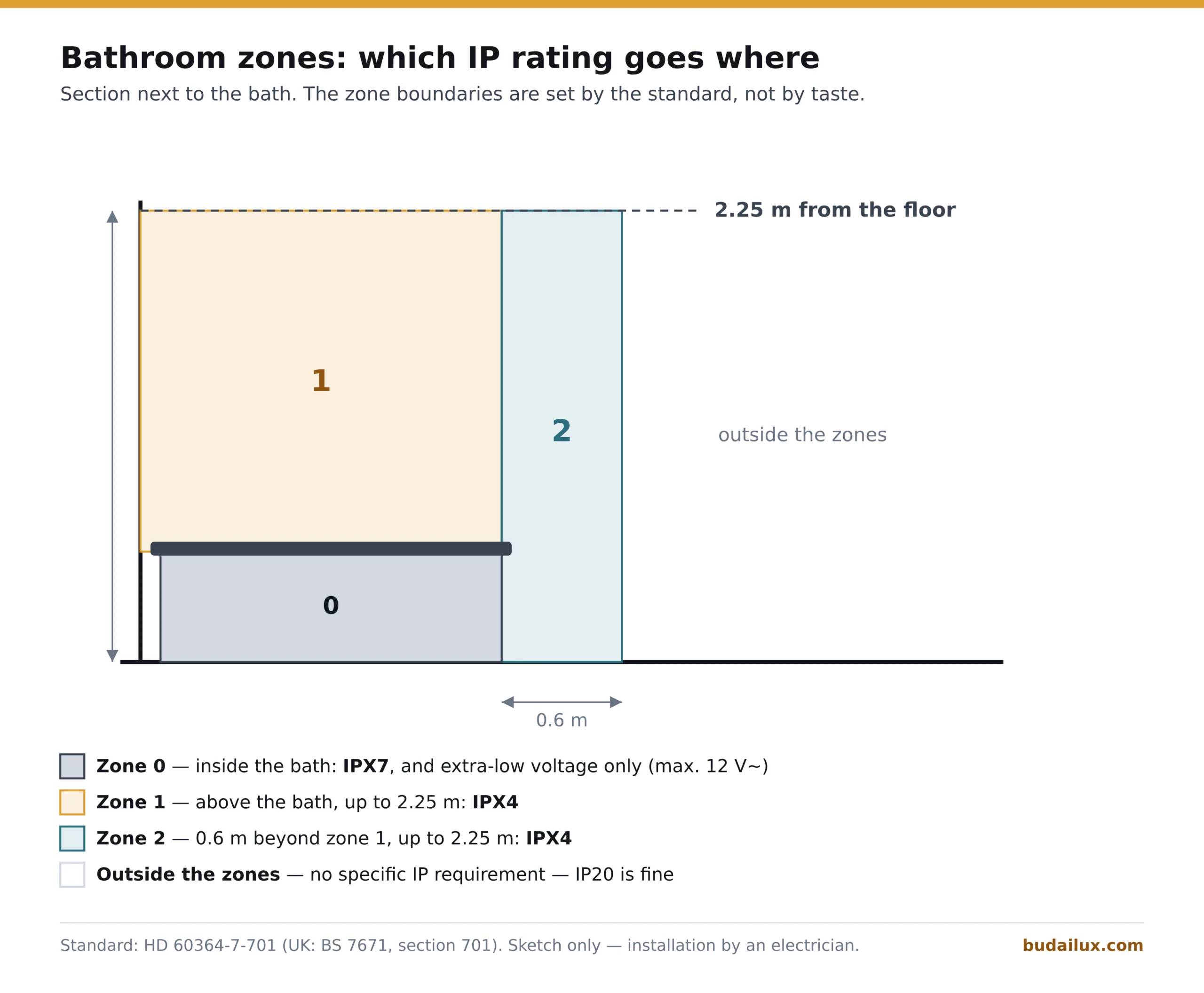
HD 60364-7-701 recognises three zones (0, 1 and 2): the zone 3 still mentioned in older descriptions no longer exists in the current standard, and the basic requirement in zone 1 is IPX4, not IP65. Where the room is regularly cleaned with water jets — in public baths, for example — zones 1 and 2 need IPX5.
Two common misconceptions. The first is that mirror lighting is “far enough away anyway” — a light above the washbasin often falls into zone 2, so it needs IPX4. The second is that an IPX4 marking also means dust protection: it doesn’t; the X only means that type of protection was not tested or is not stated.
What does the IP rating NOT tell you?
This part is missing from most guides, even though most outdoor lights are not destroyed by water. The IP classification says nothing about four things:
- UV resistance. Sunlight yellows plastic diffusers and makes them brittle. The diffuser of an IP65 light can crack within three years — and from then on the IP rating is worth nothing. This is a question of material, not of seals.
- Corrosion. Salty or chlorinated moisture eats into metal housings and screws. Outdoors, what counts is a stainless steel or powder-coated aluminium housing, not a higher IP number.
- Impact resistance. This has its own marking: the IK code (EN 62262), from IK00 to IK10. For lights in public areas or within children’s reach, it matters at least as much.
- Condensation inside. In a perfectly sealed luminaire, warming up during the day and cooling down at night can cause condensation. That is why a good outdoor light has a breather membrane — which doesn’t reduce the IP rating, but lets the moisture out.
And a fifth thing it doesn’t cover: the IP rating applies to a correctly installed light. If the sealing ring slips out, the cable gland isn’t tightened, or the light is mounted in a different orientation from the one the manufacturer specifies, an IP65 product is no longer IP65 in practice. This is one more reason to have outdoor lights installed by a qualified electrician.
Frequently asked questions
Is IP44 good enough outdoors?
In covered places, yes: under a canopy, on a covered terrace, in a porch. On a wall exposed directly to rain, IP44 is the bare minimum, and IP54 or IP65 is the better choice there. At ground level, where watering and splashing mud reach it, IP44 is not enough.
What is the difference between IP44 and IP65?
Both digits differ. IP44 protects against objects over 1 mm and splashing water; IP65 is dust-tight and also withstands water jets. In practice: IP44 is for covered places, IP65 for the open air, exposed directly to the weather.
What does the IPX4 marking mean?
The X means that type of protection was not tested or is not stated. An IPX4 light is therefore protected against splashing water, but there is no information about its dust protection. It is the usual marking for bathroom lights, because water protection is what matters there.
Is IP68 better than IP65 in every way?
No. The 8 means continuous immersion, the 5 means water jets — two different tests. An IP68 light will not necessarily withstand water jets. If both are needed, the manufacturer must mark both, for example as IP65/IP68.
Is the IP rating enough when choosing an outdoor light?
No. Check the housing material (stainless steel or powder-coated aluminium lasts longer), the UV resistance of the diffuser, and, if it goes in a public area, the IK impact rating too. Most outdoor lights fail because of sunlight and corrosion, not water.
To work out how much light you need, use our lighting calculators.
Sources
- IEC 60529:1989+AMD1:1999+AMD2:2013 — Degrees of protection provided by enclosures (IP Code) — the international standard for the IP code; in Europe it applies as EN 60529.
- IEC: Ingress Protection (IP) ratings — the standards body’s free summary of what the two digits mean.
- IEC 60364-7-701:2019 — Locations containing a bath or shower — the international basis for bathroom zones and IP requirements; in Europe it applies as HD 60364-7-701, in the UK as BS 7671 section 701.
- IEC 62262:2002+AMD1:2021 — IK code — the standard for impact protection levels (IK00–IK10); European reference EN 62262.