The CE marking is on almost every light, bulb and LED strip, yet few people know what it actually claims. It is not a quality mark, and it is not an official approval: it is the manufacturer’s own declaration that the product meets EU rules. How much that declaration is worth is shown not by the shape of the two letters but by the documents behind it and the company that answers for it.
Below we look at which EU rules apply to a light, what should be on the light and on the product page, what the declaration of conformity contains, and what the European Commission says about the “China Export” mark. We also give you an eight-point checklist.
What does the CE marking on a light mean?
With the CE marking, the manufacturer itself declares that the light meets the EU requirements that apply to it. It is not a quality mark and not an official approval. Whether it is genuine is shown not by the shape of the letters, but by the EU declaration of conformity and the name and address of the company in the EU that is responsible for the light.
As defined in law, by affixing the CE marking the manufacturer indicates that the product complies with the applicable EU harmonisation legislation and takes responsibility for it (Regulation (EC) No 765/2008, Articles 2 and 30). Only the manufacturer or its authorised representative may affix it, at least 5 mm high, to the light or its rating plate; if it does not fit there, to the packaging and the accompanying documents.
For lights, there is no “CE test” by an official body. The procedure is called internal production control: the manufacturer draws up the technical documentation, assesses the risks and makes the declaration on its sole responsibility (Directive 2014/35/EU, Annex III). The law does not require independent laboratory testing.
The European Commission says so explicitly: the CE marking does not mean that the product has been approved as safe by the EU or by any authority, and it does not indicate where the product was made (European Commission: CE marking). In a 2024 answer to the European Parliament it added that CE does not guarantee a product’s quality.
Which EU rules apply to a light?
A mains-powered light is typically covered by three directives, all of which require CE marking, plus two regulations specific to light sources. If a product falls under several pieces of legislation, the manufacturer issues a single declaration of conformity listing them all (Directive 2014/35/EU, Article 15(3)).
| Rule | What it covers for a light | What you will see |
|---|---|---|
| 2014/35/EU Low Voltage Directive (LVD) | Electrical safety between 50 and 1000 V AC (75 and 1500 V DC): electric shock, overheating, fire | CE, protection class symbol, rated values, instructions in the local language |
| 2014/30/EU EMC Directive | The light must not interfere with other equipment, and must not itself be too sensitive to interference | CE |
| 2011/65/EU RoHS Directive | Restricts lead, mercury, cadmium, hexavalent chromium, certain flame retardants and phthalate plasticisers | CE |
| (EU) 2019/2020 Ecodesign Regulation | Efficiency, flicker and lifetime data of light sources; for light fittings, whether the light source can be replaced | details on the box, replaceability marking |
| (EU) 2019/2015 Energy Labelling Regulation | The energy label of light sources and their registration in the EU’s EPREL product database | label with QR code (on light sources) |
| (EU) 2023/988 General Product Safety Regulation (GPSR) | Mandatory details in online listings, reporting of accidents, recalls | manufacturer and EU responsible person details in the online shop |
| 2014/53/EU Radio Equipment Directive | For smart lights with Wi-Fi, Bluetooth or Zigbee, this replaces the LVD and the EMC Directive | CE |
The energy label is only mandatory for light sources. A light fitting’s box has no label; instead, the instructions must include the sentence “This product contains a light source of energy efficiency class <X>”. The exception is a fitting that cannot be dismantled to check the light source: the regulation then treats the whole light as a light source, and it gets a label (Regulation (EU) 2019/2015, Article 2 and Annex V).
Who is responsible for a light being compliant?
Responsibility is shared along a chain: the manufacturer assesses conformity and makes the declaration, the importer checks the manufacturer and answers for the light in the EU, and the shop must not sell a light that lacks the mandatory markings.
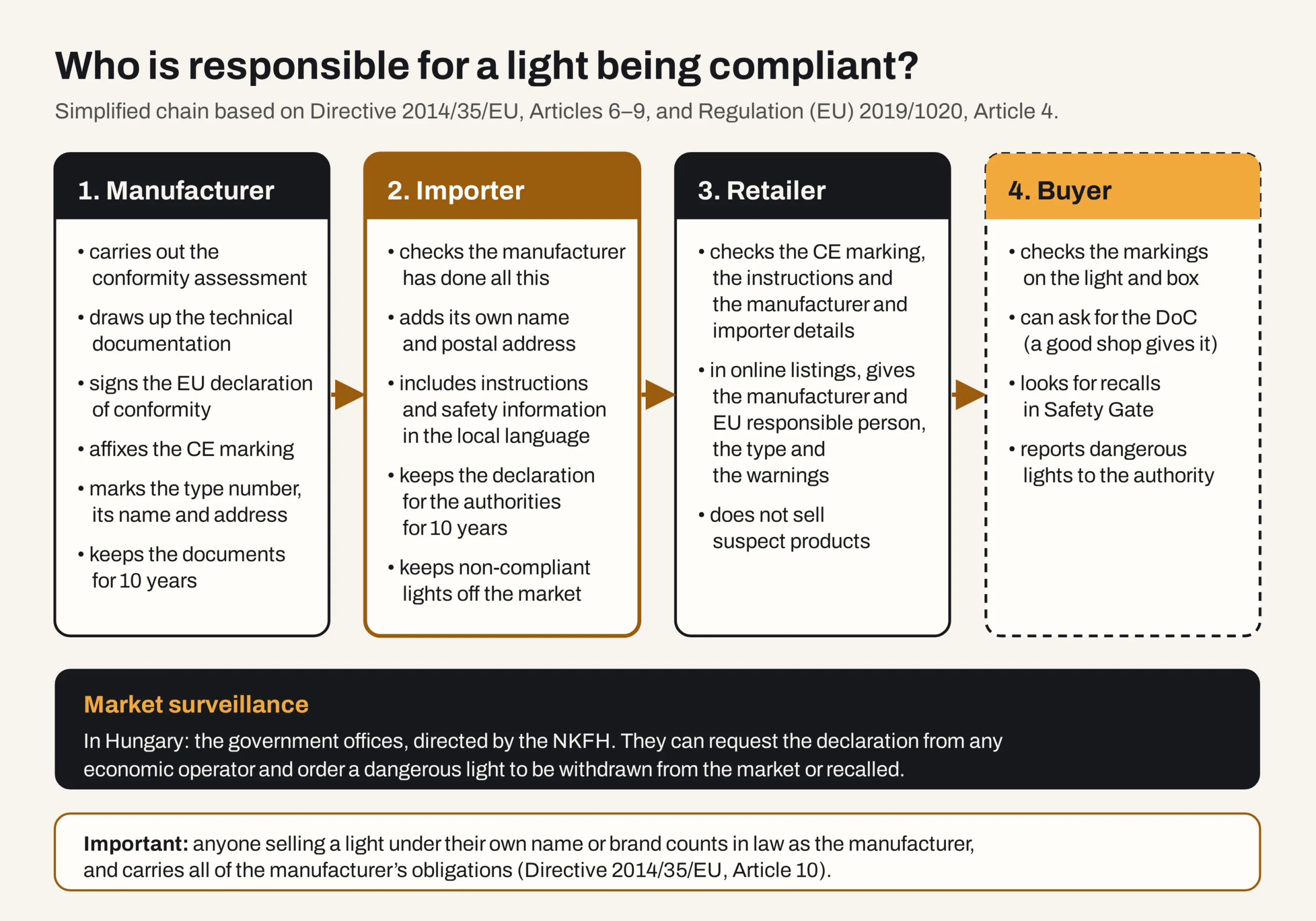
The manufacturer draws up the technical documentation, signs the declaration, affixes the CE marking and keeps the documents for 10 years (Directive 2014/35/EU, Article 6). The importer — the company that first places a light made outside the EU on the EU market — checks all of this before placing it on the market, puts its own name and postal address on it, includes the instructions and safety information, and keeps a copy of the declaration available to market surveillance authorities for 10 years (Article 8). The instructions have to be in a language consumers can easily understand, as decided by each member state; in Hungary that means Hungarian, under Decree 23/2016 (VII. 7.) NGM.
Since 16 July 2021, these products may only be placed on the market if there is an economic operator established in the EU (manufacturer, importer, authorised representative or fulfilment service provider) that answers for them to the authorities, and whose name and postal address appear on the product, its packaging or an accompanying document (Regulation (EU) 2019/1020, Article 4).
One important detail: anyone who places a light on the market under their own name or brand is treated in law as the manufacturer, and carries all of the manufacturer’s obligations. The same applies to anyone who modifies a light in a way that can affect its compliance (Directive 2014/35/EU, Article 10).
What should be on the light, its box and the product page?
The light — or, if there is no room, its box — must show the CE marking, a type, batch or serial number, the manufacturer’s name and postal address and, for a manufacturer outside the EU, the importer’s name and postal address. The box must contain instructions and safety information in the local language.
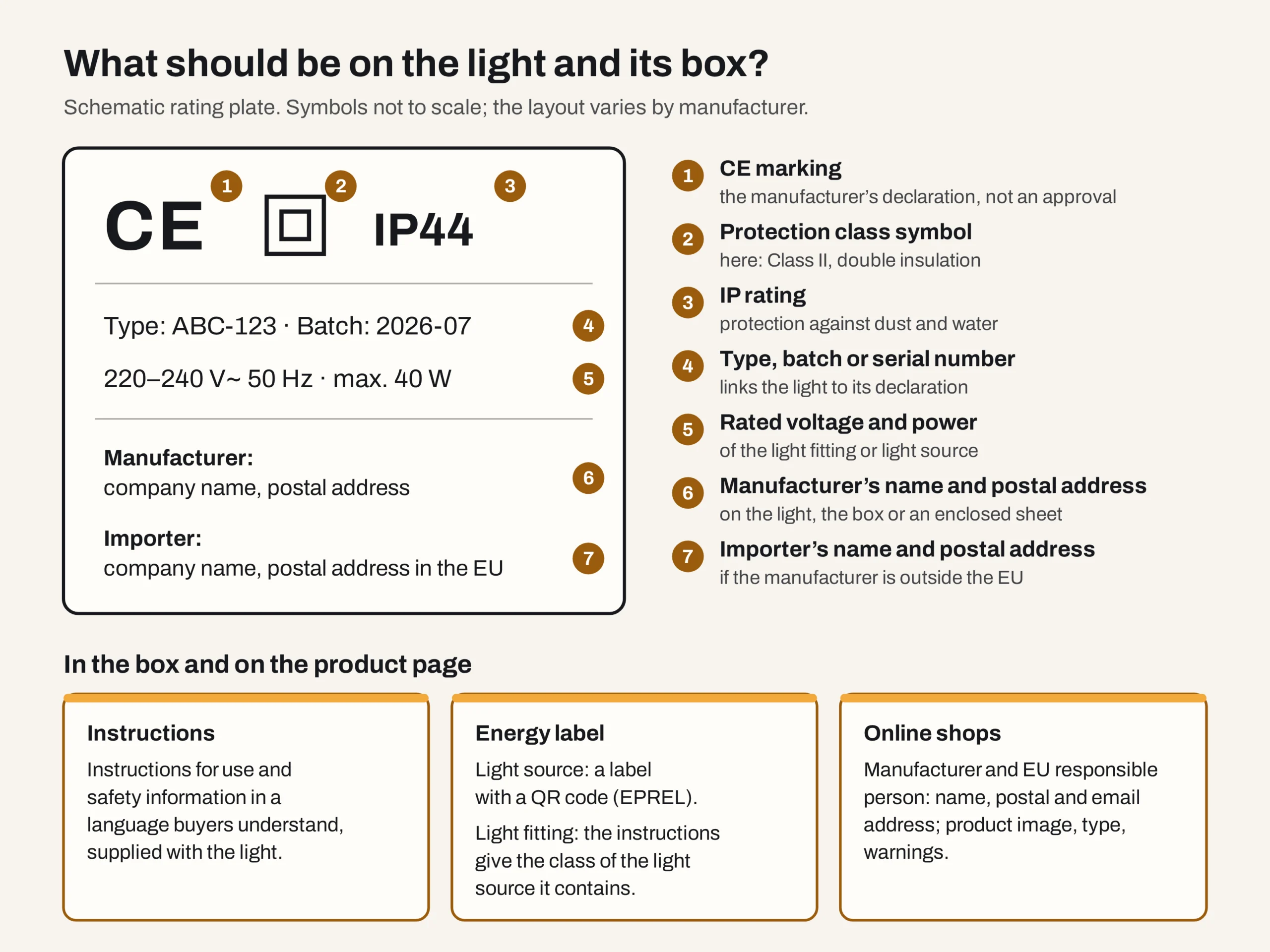
The protection class symbol, the rated voltage and power, and the IP rating are required by the safety standard for light fittings, EN IEC 60598-1. We explain what the IP number means in a separate article.
Since 13 December 2024, the product page of an online shop must show clearly and visibly: the manufacturer’s name, postal and electronic address; for a manufacturer outside the EU, the name, postal and electronic address of the EU responsible person; information identifying the product, including a picture of it and its type; and the mandatory warnings and safety information in a language the buyer can easily understand (Regulation (EU) 2023/988, Article 19). This also applies to CE-marked lights.
What does the EU declaration of conformity contain?
The EU declaration of conformity (DoC) is a signed document of one or two pages in which the manufacturer declares, on its sole responsibility, that the product complies with the EU legislation listed. Its mandatory content (Directive 2014/35/EU, Annex IV):
- Product model identification: product, type, batch or serial number.
- Name and address of the manufacturer or its authorised representative.
- A statement that the declaration is issued under the sole responsibility of the manufacturer.
- Object of the declaration: identification of the light allowing traceability, which may include a colour photo.
- The relevant EU legislation the product complies with. For a light, typically Directives 2014/35/EU, 2014/30/EU and 2011/65/EU.
- The harmonised standards applied (for a light fitting, for example EN IEC 60598-1) or other technical specifications.
- Additional information, place and date of issue, and the name, function and signature of the signatory.
The general model in Annex III to Decision No 768/2008/EC follows the same structure, which is why a single declaration can cover all the directives. The declaration must be kept up to date.
If you have a copy of the declaration, check four things. The type number should match the one on the light. The issuer’s name and address should match the manufacturer named on the light. It should be dated and signed. And for a mains-powered light, it should list at least Directive 2014/35/EU. A “CE certificate” on a laboratory letterhead is no substitute for the declaration: voluntary certificates are not accepted in law as the basis for CE marking (Your Europe: CE marking).
How do you check the CE marking on a light?
The eight steps below work in a shop and online alike. None of them needs any equipment, and together they tell you far more than the shape of the letters.
- CE marking on the light. On the rating plate or the light itself, legible and indelible; only on the box if it does not fit there.
- Name and postal address of the manufacturer and importer. A brand name or a website is not enough. If the manufacturer is outside the EU, look for the name and address of the EU importer or responsible person.
- Type, batch or serial number. This links the light to its declaration and to any recalls.
- Instructions and safety information in your language. In the box, covering installation and safety.
- Energy label or energy class. For a light source, a label with a QR code leading to its record in the EPREL database; for a light fitting, the class of the light source it contains, stated in the instructions.
- Credible technical data. Luminous flux (lm), power (W), colour temperature (K) and, where relevant, the IP rating should all be stated. We cover how lumens and watts relate in our guide to the numbers on the box.
- Declaration of conformity on request. Ask the seller for it and compare the type number with the one on the light.
- Recalls. Search for the type and the brand in the EU’s Safety Gate system and, in Hungary, in the NKFH dangerous products database.
The “China Export” mark: does the letter spacing really give a fake CE away?
You often read online — and in AI answers — that on the “China Export” mark the C and the E sit closer together, so the letter spacing tells you whether a CE marking is fake. This advice is misleading.
The European Commission has answered parliamentary questions on this twice. In 2008 it wrote that it was not aware of the existence of a “China Export” mark; it regarded the mark in question as a CE marking that does not respect the prescribed proportions. It added that the CE marking is misused: it is put on non-compliant products, and conversely, formally incorrect markings also appear on compliant ones (P-5938/2007).
In 2024 the Commission said that the “China Export” logo looks almost the same as the CE marking, only with the two letters closer together, and pointed out that EU law prohibits markings that are misleading as to the meaning or form of the CE marking (E-001996/2024; Regulation (EC) No 765/2008, Article 30(5)).
The practical conclusion: the shape of the letters shows at most that someone drew the mark carelessly. Anyone can print a perfectly proportioned CE on a dangerous light, because the manufacturer affixes the mark itself. A reliable check therefore comes down to two questions: which company in the EU answers for this light, and can it produce the declaration of conformity for the same type number?
What are the warning signs on a light or in an online listing?
One warning sign does not prove a light is dangerous, but several together are reason enough to be suspicious:
- No manufacturer name and postal address — just a brand name, or nothing.
- A manufacturer outside the EU, but no EU company with an address named anywhere.
- No type number, or a different one on the box than on the light.
- A “certificate” instead of a declaration, with a different type number, or no date or signature.
- No manufacturer or responsible-person details on the product page, and no answer when you ask.
Where to turn if a light seems dangerous
If a light overheats, sparks or has given someone an electric shock, stop using it and tell the seller. The manufacturer must report accidents to the authorities, and the importer and distributor must inform the manufacturer (Regulation (EU) 2023/988, Article 20).
In Hungary, market surveillance of electrical products is carried out by the consumer protection authority: the Budapest and county government offices, under the professional direction of the National Trade and Consumer Protection Authority (NKFH). On the NKFH’s Dangerous products page you can search the products banned in Hungary and report a new dangerous product. Its customer service line, free to call within Hungary, is 06 80 310 020. Elsewhere in the EU, contact that country’s market surveillance authority.
The EU’s Safety Gate system lets you search alerts from all member states; it is worth searching for both the type number and the brand name.
Frequently asked questions
Does every light need a CE marking?
In practice, yes. The EMC and RoHS Directives apply to every electric light, and the Low Voltage Directive also applies to mains-powered ones; all three require CE marking. A battery or 12 V light needs CE too, just not under the Low Voltage Directive.
What is the difference between a declaration of conformity and a certificate?
The declaration of conformity is issued and signed by the manufacturer; it is the legal basis of the CE marking. A certificate or test report is a laboratory document: it can be part of the technical documentation, but it does not replace the declaration. So-called voluntary “CE certificates” are not recognised in law.
Can I ask the shop for the declaration of conformity?
You can. For an ordinary light, the law requires the declaration to be made available to market surveillance authorities, not to buyers, but a trustworthy retailer will usually provide it anyway. For a smart light, the declaration or a simplified version of it must come with the product (Directive 2014/53/EU, Article 10(9)).
Can a CE marking expire?
No: CE shows that the light met the rules when it was placed on the market. But if someone modifies it — for example by fitting a different power supply — the manufacturer’s declaration no longer covers it, and the law may treat the person who modified it as the manufacturer.
Sources
- Directive 2014/35/EU of the European Parliament and of the Council on electrical equipment designed for use within certain voltage limits (Low Voltage Directive), EUR-Lex.
- Regulation (EU) 2023/988 of the European Parliament and of the Council on general product safety (GPSR), EUR-Lex.
- The European Commission’s answers on the “China Export” mark: E-001996/2024 (30 November 2024) and P-5938/2007 (12 March 2008), European Parliament.
- European Commission: CE marking and Your Europe: CE marking.
- Hungarian National Trade and Consumer Protection Authority (NKFH): Dangerous products (in Hungarian); European Commission: Safety Gate.