The light above the bathroom mirror is one of the hardest-working lights in the home: you need it for shaving, make-up and contact lenses, every morning, at close range. If it is in the wrong place or its light is wrong, a shadowy, pale face looks back at you from the mirror — and because of the moisture in a bathroom, the safety requirements are stricter than in the rest of the home.
Below we go through where the light should come from, how big the light should be, how much light you need at the face, which light colour and colour rendering suit a mirror, and which bathroom zone can take a light with which IP rating.
What kind of light do you need above the bathroom mirror?
One that lights the face evenly, from the front and from the sides: 3000–4000 K light with a colour rendering of at least Ra 90, and roughly 500 lux at the face. If it falls within one of the zones of the bath or shower, it needs at least IPX4. Wiring it in is a job for an electrician, behind a 30 mA residual current device (RCD).
Mirror lighting is not the bathroom’s general light but task light: it has to light a small area — the face — well. The ceiling light can’t do this, because the person standing at the mirror casts a shadow on their own face. That’s why the mirror needs its own light, in addition to the ceiling light. The principle of lighting layers — ambient, task and accent light — is shown with numbers in our article on living room chandeliers.
Because of water, the standard divides the bathroom into zones, and each zone has a minimum IP rating. The meaning of the IP code and the basics of the zones are described in our article on IP ratings; here we concentrate on where the washbasin and the mirror fall.
Should a mirror light shine from above or from the sides?
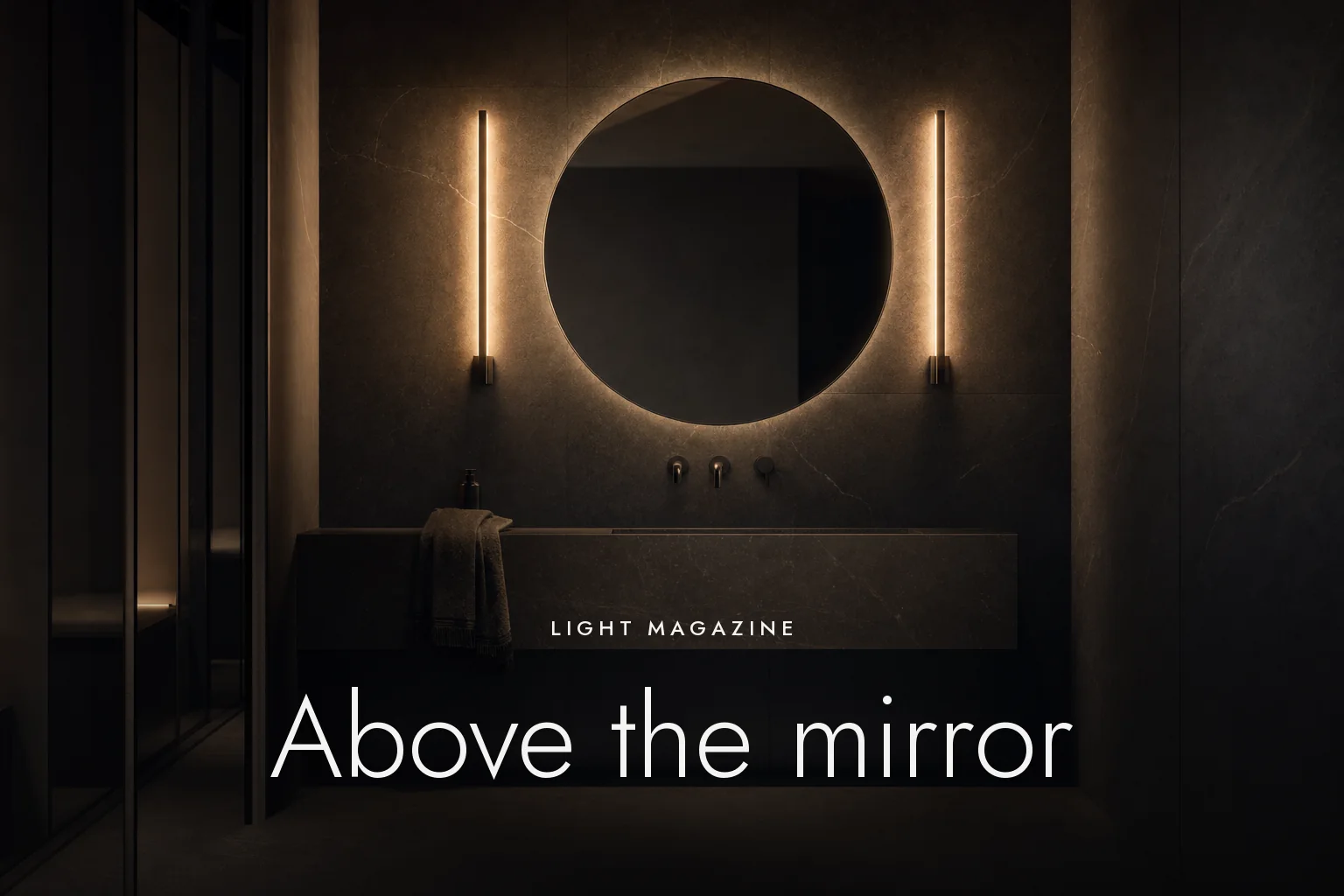
The best light for the face comes from the side, at face height — ideally from both sides at once. That way the light fills the eye sockets and the areas under the nose and chin, and both halves of the face are equally bright. Light that comes only from above casts shadows under the eyebrows, nose and chin — exactly where you need to see when shaving or putting on make-up.
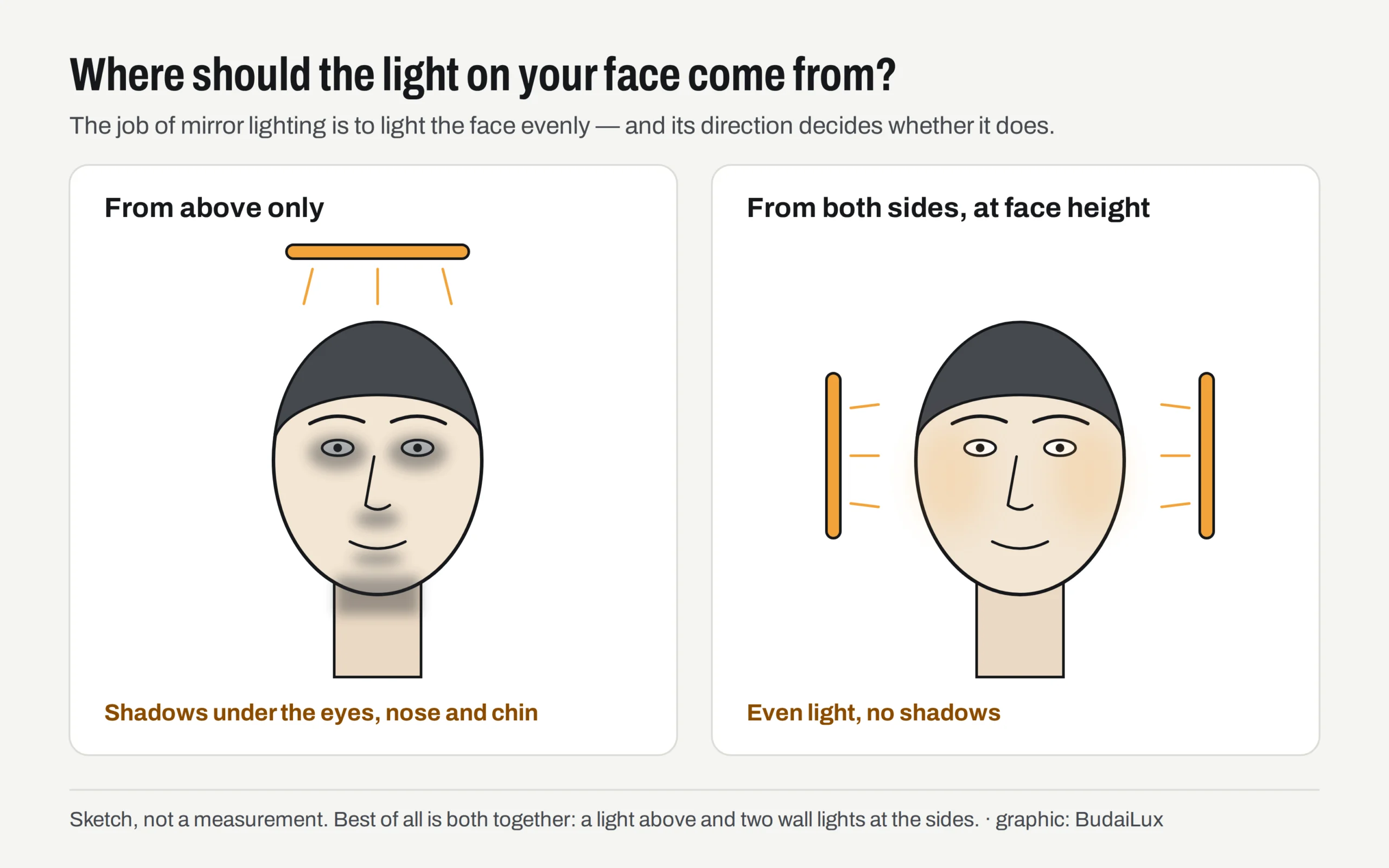
If you can only put a light above the mirror, three things help a lot: it should be wide, sit directly above the top edge of the mirror, and shine forwards, towards the face as well — not just down into the basin. A diffuse light with an opal shade casts fewer sharp shadows than a point-like spotlight. The best solution is both together: a light above plus two bathroom wall lights at the sides, or a strip of light running all the way round the mirror.
How big should the light above the mirror be, and where should it go?
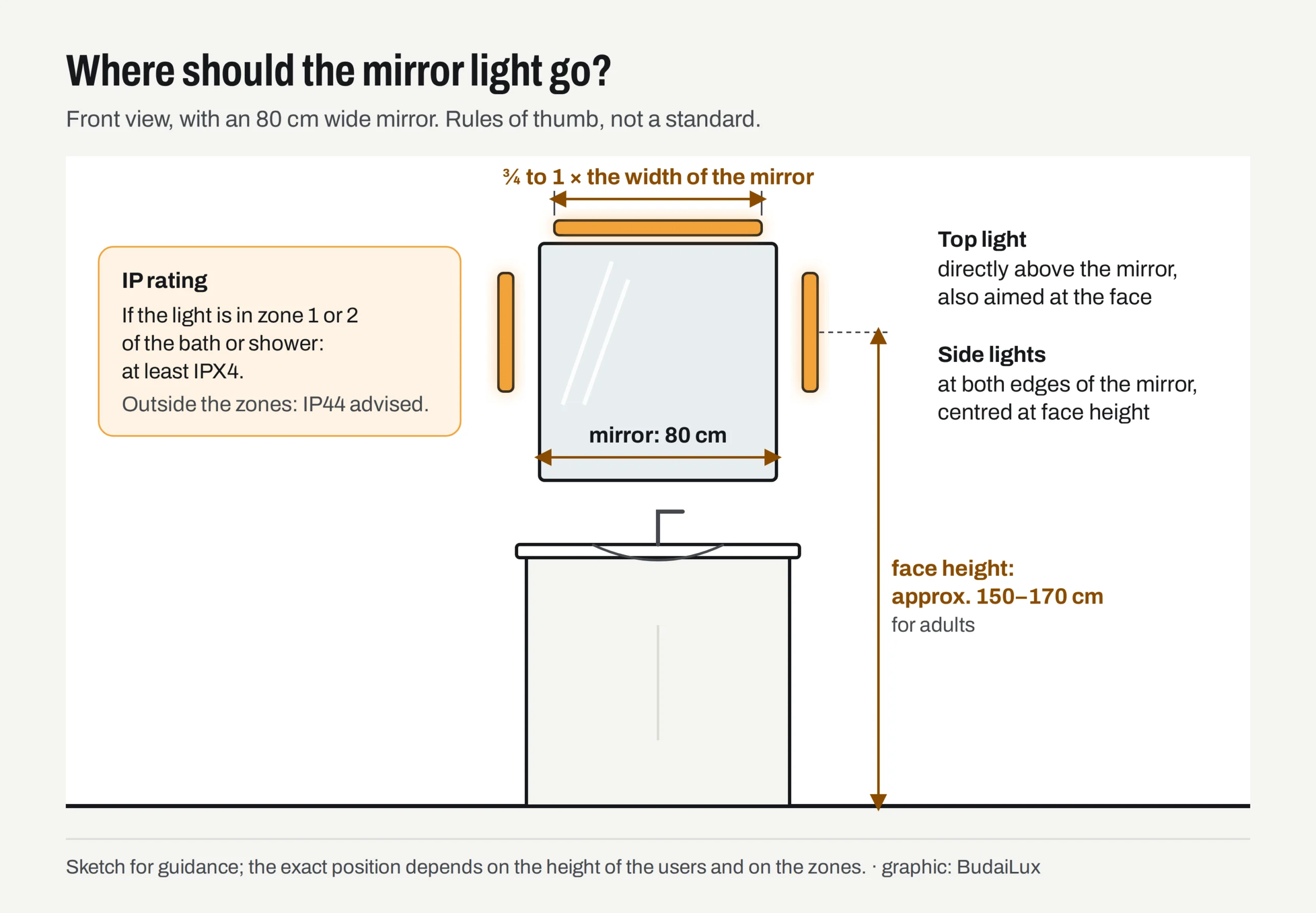
There is no standard for this, only a well-tried rule of thumb: the light above the mirror should be at least three-quarters of the mirror’s width, but no wider than the mirror. Side lights should sit at the two edges of the mirror, roughly at face height, so that the light reaches the face horizontally.
| Mirror width | Length of the top light | Side lights |
|---|---|---|
| 50 cm | 40–50 cm | Two narrow wall lights, one on each side of the mirror |
| 60 cm | 45–60 cm | Two wall lights, with the centre of the light source at face height |
| 80 cm | 60–80 cm | Two wall lights or a vertical strip of light |
| 100 cm | 75–100 cm | Two wall lights or a strip of light running all the way round |
| 120 cm or more | 90–120 cm, or two separate lights for two basins | A pair of side lights for each basin |
The light colour and style of the light and the mirror should match the bathroom’s other lights. If the light above the mirror has a shade, measuring and replacing it is covered in our guide to lampshades and light shades — in a bathroom, use only the shade and seal supplied by the manufacturer for that light.
How many lux do you need at the face, and how many lumens should the light have?
Around 250 lux is enough for the bathroom’s general light, but at the mirror, at face height, the target is about 500 lux. That is also what the lumen calculator below uses. There is no mandatory lighting standard for homes, but the European standard for workplace lighting, EN 12464-1, gives the same level for the workplace in a hairdressing salon: according to the table in its 2011 edition, 500 lux and a colour rendering of Ra 90.
A simple calculation shows the order of magnitude of light this takes — it is an estimate, not a measurement. If there is a 60 cm long, diffuse light of 1,000 lm above the mirror that also shines forwards, or a 500 lm light on each side, then at half a metre you get roughly 500–700 lux on the face, not counting reflections from the walls and the mirror. A light that shines only downwards onto the basin gets much less onto the face.
Always check the luminous flux on the box in lumens, not watts. The difference between the two units is explained in our article on the numbers on a light bulb box, and the total light needed room by room in our guide to how many lumens you need.
How much light does your room need?
Lumens are the amount of light, watts are the consumption — the two are not the same. Enter your room's details and we'll tell you how much total luminous flux you need, and how best to split it into three layers.
Guide values for a 15 m² room
| Room | Illuminance | Total luminous flux | Colour temperature |
|---|---|---|---|
| Living room | 150 lux | 2,500 lm | 2700–3000 K |
| Dining room | 175 lux | 2,900 lm | 2700 K |
| Kitchen | 300 lux | 4,950 lm | 3000–4000 K |
| Bedroom | 125 lux | 2,050 lm | 2700 K |
| Bathroom | 250 lux | 4,150 lm | 3000–4000 K |
| Study | 300 lux | 4,950 lm | 3000–4000 K |
| Children's room | 200 lux | 3,300 lm | 3000 K |
| Hallway, corridor | 150 lux | 2,500 lm | 2700–3000 K |
| Terrace, outdoors | 75 lux | 1,250 lm | 2700 K |
How we calculate: illuminance (lux) × floor area (m²), then multiplied by the corrections for ceiling height and wall colour. Lux tells you how much light reaches a surface, lumens how much the light emits — which is why the lumens you need depend on the size of the room. The result is a design guide value, not a measurement: the real illuminance also depends on where the lights are placed and how they distribute light.
What light colour and CRI does a mirror need?
A mirror calls for light of 3000–4000 K. Neutral white at 4000 K doesn’t give the skin a yellowish tint, so it is good for daytime make-up; 3000 K is more pleasant in the evening and fits in better with the warm white lights in the rest of the home. On some mirrors with built-in LED lighting, the light colour can be changed with a switch, so you get both. Our article on the colour temperature scale shows the difference between light colours.
The colour rendering index (CRI, symbol Ra) shows how faithfully colours appear in a light. As defined by the International Commission on Illumination (CIE), Ra is the average of the colour rendering indices for eight standard test colours, with a maximum of 100. The EU ecodesign regulation requires at least Ra 80 for most light sources.
For make-up, at least Ra 90 is recommended, because with foundation, blusher and lipstick everything depends on the shades of skin and make-up. In light with poorer colour rendering, skin can look duller and greyer, and what looked right in the mirror turns out to be a different colour in daylight. It is also worth checking R9, which measures how saturated red is rendered and matters for skin tones: its value is listed in the product’s entry in the EU product database (EPREL). If several lights sit side by side, their colour consistency (SDCM) should be 3 or less, so that their light matches.
Which zone is the mirror in, and what IP rating do you need?
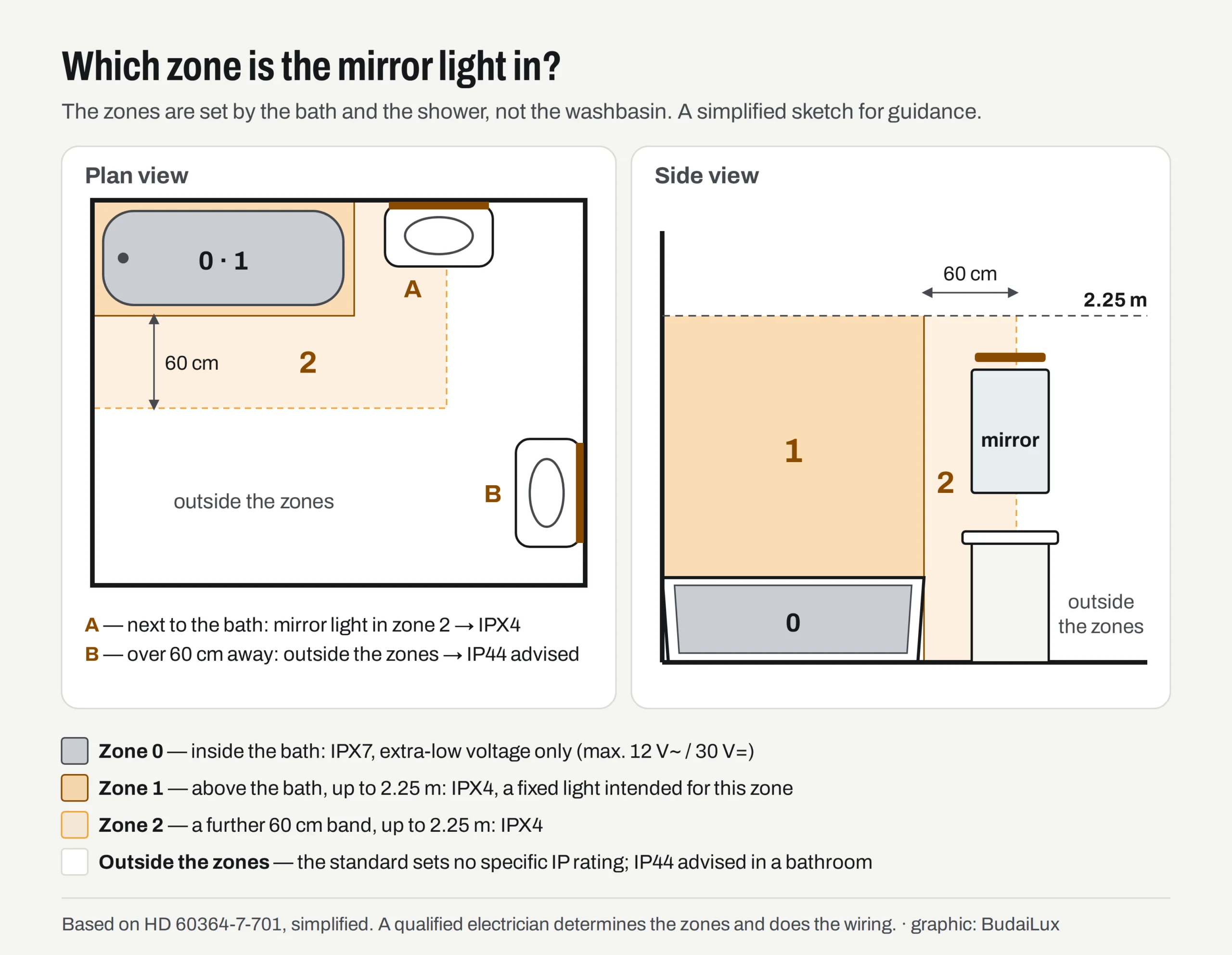
The zones are defined by the bath and the shower, not the washbasin. So the mirror light only falls within a zone if the washbasin is close to the bath or shower: within 60 cm of the edge of the bath, up to a height of 2.25 m, it is in zone 2, and there it needs a light rated at least IPX4. If the washbasin is further away, the light is outside the zones.
| Zone | Where is it? | Minimum | What light can go there? |
|---|---|---|---|
| Zone 0 | Inside the bath or shower tray; for a shower without a tray, the 10 cm above the floor. | IPX7 | Only a fixed light intended by its manufacturer for this zone, running on extra-low voltage of at most 12 V AC or 30 V DC. |
| Zone 1 | Above the bath or tray up to 2.25 m, or up to the fixed shower head if that is higher; for a shower without a tray, up to 1.2 m from the fixed water outlet. | IPX4 | A fixed, permanently connected luminaire that its manufacturer also permits in zone 1. |
| Zone 2 | A further 60 cm band beyond the edge of zone 1, up to 2.25 m. | IPX4 | An IPX4 luminaire. A mirror light above a washbasin next to the bath often falls here. |
| Outside the zones | Anything further away or higher up. | IP20 | The standard sets no specific IP rating; because of the humidity, an IP44 light intended for bathrooms is recommended. |
The current international basis is IEC 60364-7-701:2019. Its new edition describes the zones more precisely, and zones 0, 1 and 2 around the bath are still there. In Hungary, two editions of the standard currently apply side by side: the Hungarian-language MSZ HD 60364-7-701:2007, which will be withdrawn on 6 December 2027, and the English-language MSZ HD 60364-7-701:2025, valid since 1 May 2025, which is based on IEC 60364-7-701:2019.
The zone 3 still mentioned in older descriptions does not exist in the current standard. Outside the zones, the standard also allows IP20, but a bathroom is humid: lights intended for bathrooms are typically IP44, and it is worth choosing one of these above the mirror too. An IP44 light also meets the IPX4 requirement, because its second digit stands for the same level of water protection, 4.
A mirror with built-in LED lighting, or a separate light?
Both can work, as long as the light reaches your face. A common trap with mirrors that have built-in LED lighting is that they only shine backwards, onto the wall: that makes a nice accent light, but it hardly reaches the face. Before buying, check whether the mirror has a strip of light shining forwards, towards the face, and how many lumens it gives.
| Aspect | LED mirror | Separate mirror light |
|---|---|---|
| Direction of light | From the front, at the edges of the mirror or all round it — but many models only shine backwards, onto the wall. | From above or from the sides, depending on the light and where it is mounted. |
| Replacing the light source | Integrated LED; the manufacturer must state whether it can be replaced. | Often a replaceable light source or LED module. |
| Protection | The IP rating given for the mirror is what counts; check its marking. | The IP rating of the luminaire is what counts. |
| Connection | Fixed wiring or a plug; a demister heater is an additional load. | Fixed wiring to a connection box above or beside the mirror. |
Who should wire in a bathroom mirror light?
Leave the wiring of a bathroom light to an electrician. Under the standard, the lighting and socket circuits in a bathroom must be protected by a 30 mA residual current device (RCD), and an electrician can also determine which zone the mirror light falls into and what kind of light can be installed there.
If there is already a connection point above the mirror, replacing the light is simpler, but in a bathroom it still has to be checked that the old connection box and the wiring are suitable for the new light. Wire colours and testing are covered in our article on live, neutral and earth wires, and the steps of the wiring in our guide to wiring a ceiling light or chandelier.
Safety note. In a bathroom, the closeness of water and earthed metal surfaces increases the risk of electric shock. Before any work, the circuit breaker for the circuit has to be switched off and the wires checked with a two-pole voltage tester to make sure they are dead — a neon test screwdriver is not reliable for this. If you don’t know whether the bathroom circuits are protected by a 30 mA RCD, or which zone the light falls into, call an electrician. Only a light whose markings and instructions suit the location should be installed there.
Frequently asked questions
What IP rating does a bathroom mirror light need?
If the light falls within zone 1 or 2 of the bath or shower, it needs at least IPX4; above a washbasin next to the bath, this is often the case. If the washbasin is outside the zones, the standard sets no specific rating, but because of the humidity it is worth choosing an IP44 light intended for bathrooms there too.
What colour temperature is best for make-up?
Between 3000 and 4000 K. Neutral white at 4000 K doesn’t give the skin a yellowish tint; 3000 K is more pleasant in the evening. Colour rendering matters at least as much: for make-up you need Ra 90 or better, otherwise make-up looks a different colour in the mirror than in daylight.
Is a ceiling light enough for a bathroom?
It can be enough for general light, but not for the mirror. A person standing at the mirror shades the light from the ceiling with their own head, so their face stays darker. The mirror needs a separate light that shines towards the face.
How high should the light above the mirror be?
Directly above the top edge of the mirror, so that the light reaches the face from as close as possible, and from the front. With side lights, the centre of the light source should be roughly at face height — typically 150–170 cm for adults. If the light is below 2.25 m and within 60 cm of the bath, it needs IPX4.
Can an IP20 light be used in a bathroom?
Outside the zones, the standard allows it; in zones 0, 1 and 2 it doesn’t. Since a bathroom is humid and the zone boundaries are easy to misjudge, in practice it is worth choosing an IP44 light specifically intended for bathrooms.
Sources
- Hungarian Standards Institution (MSZT), standard records (in Hungarian): MSZ HD 60364-7-701:2007 (Hungarian-language edition, to be withdrawn on 6 December 2027) and MSZ HD 60364-7-701:2025 (valid from 1 May 2025) — Locations containing a bath or shower.
- IEC: IEC 60364-7-701:2019 — Locations containing a bath or shower, the scope of the standard and a summary of the changes.
- Zumtobel: The Lighting Handbook (6th edition, 2018, PDF) — extracts from the tables of EN 12464-1:2011: hairdressing 500 lx, Ra 90.
- CIE (International Commission on Illumination): International Lighting Vocabulary, 17-22-111 “CIE 1974 general colour rendering index”, CIE S 017:2020.
- Commission Regulation (EU) 2019/2020 laying down ecodesign requirements for light sources and separate control gears, EUR-Lex — Ra ≥ 80 for most light sources; Article 4: information on the replaceability of the light source.