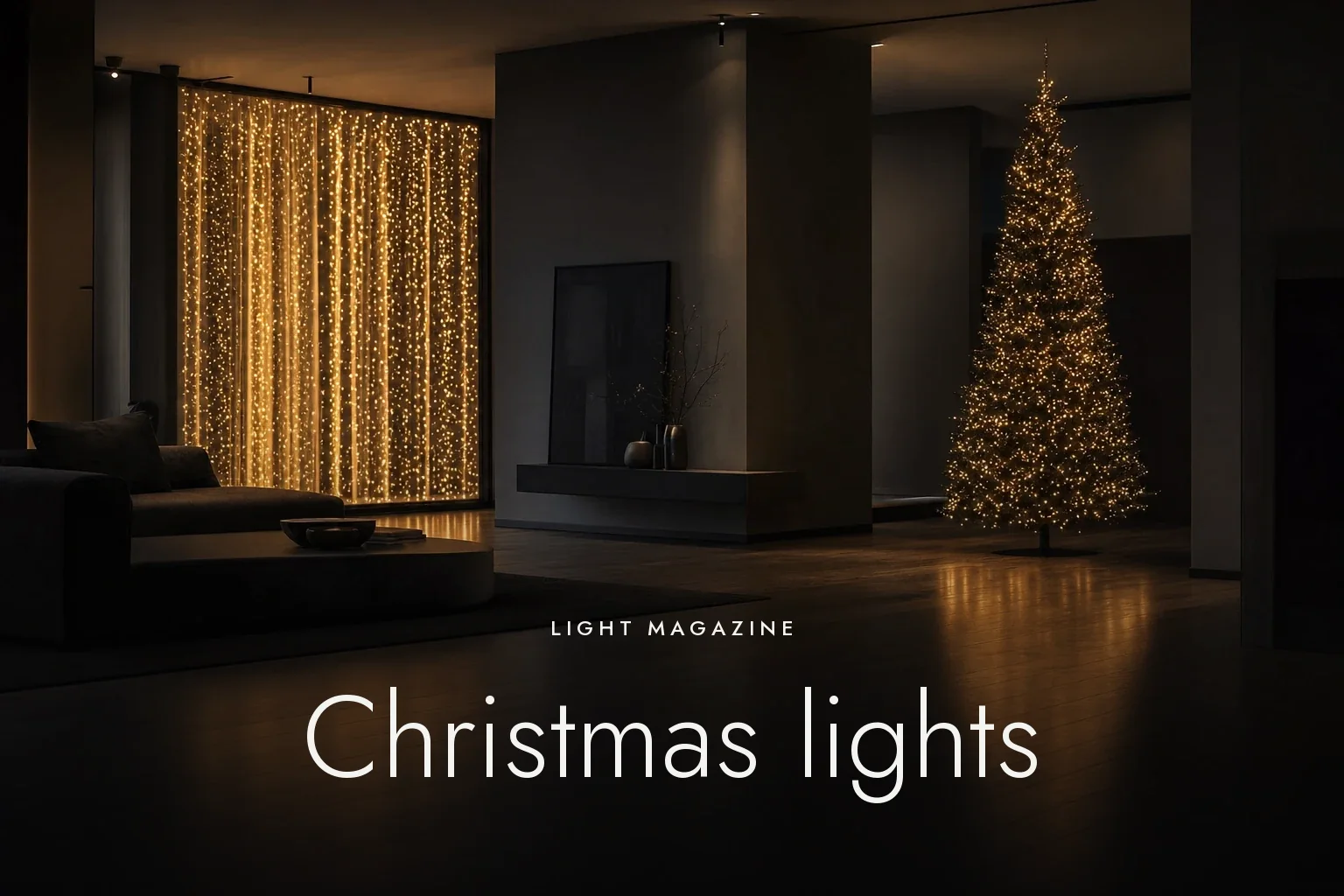
At the end of November the boxes come out: lights for the Christmas tree, a curtain light for the window, strings for the eaves and the shrubs. Christmas lights usually work for years without any trouble. When something does go wrong, the cause is typically a damaged or poor-quality string, a cable in the wrong place, or lights left on overnight.
Below we go through the most common questions: LED or traditional bulbs, how much electricity a season uses, what can go in the window and on the tree, when battery or solar string lights make sense, and how to put your lights on a timer.
How do you keep Christmas lights safe?
Indoors, any undamaged string with proper markings will do; outdoors, only an outdoor string rated at least IP44. Choose LED lights, because they barely get warm. Plug them in only once they are fully unwound, keep the tree 1.5 metres from any heat source, and switch the lights off at night — a timer helps with this. Don’t use a damaged string.
According to Hungary’s fire authority, the National Directorate General for Disaster Management, firefighters in Hungary are called out to 33 per cent more house fires during Advent than at other times of the year. In December 2024, fires broke out in 770 residential buildings there; 71 people were injured and 8 died. String lights feature in the fire authority’s holiday safety advice too: don’t use poor-quality or faulty lights bought at a market stall or in an underpass, and don’t use any string whose cable is damaged or kinked.
In December 2025, Hungary’s National Trade and Consumer Protection Authority (NKFH) examined 58 different string lights and electrical Christmas decorations and found 56 of them posed a risk of electric shock. On some, live parts could be touched freely, the cable was thinner than the standard requires, or there were no instructions in Hungarian.
So when you buy, check for the CE marking, the name and postal address of the manufacturer or EU importer, the type number and instructions in your own language. CE on its own is not a seal of quality, but if it is missing, that is a warning sign; our article on CE marking covers the details. String lights also have a product standard of their own: EN IEC 60598-2-20 (lighting chains).
LED or traditional bulbs: which Christmas lights are better?
LED lights are better: for the same number of lights they draw a fraction of the power, and they get much less warm. The Hungarian fire authority also recommends LED lights for the Christmas tree, because traditional bulbs can get hot.
You can see the difference in the manufacturers’ data. The datasheet for Konstsmide’s 16-candle indoor set with replaceable E10 bulbs gives a consumption of 48 kWh per 1000 hours, i.e. 48 W. The same manufacturer’s 20-LED candle set uses 2 kWh in 1000 hours, i.e. 2 W — a twenty-fourth as much, with more lights.
There is no need to throw out an old string with bulbs if it is undamaged, but keep a closer eye on it. Don’t cover it while it is on — manufacturers’ instructions forbid this because of the risk of overheating — and if a bulb blows, only fit a spare bulb of the voltage and wattage the manufacturer specifies (for example 14 V, 3 W). Retro-style strings with large bulbs are now also available as LED versions.
How much electricity do Christmas lights use?
Very little: at an example price of €0.30 per kWh, an LED string typically costs less than half a euro to run for a whole season, a string with traditional bulbs a few euros (in Hungary, a few tens of forints compared with several hundred). The examples below assume 6 hours a day for 40 days.
| String lights | Power | One season (240 hours) | At €0.30/kWh | In Hungary, at HUF 36 / HUF 70.10 per kWh |
|---|---|---|---|---|
| LED candle set, 20 LEDs, indoor | 2 W | 0.48 kWh | €0.14 | HUF 17 / HUF 34 |
| LED outdoor string, 240 LEDs, with 31 V transformer | 3.6 W | 0.86 kWh | €0.26 | HUF 31 / HUF 61 |
| LED outdoor string, 750 LEDs, with 31 V transformer | 6 W | 1.44 kWh | €0.43 | HUF 52 / HUF 101 |
| Candle set with bulbs, 16 bulbs, indoor | 48 W | 11.52 kWh | €3.46 | HUF 415 / HUF 808 |
| Candle set with bulbs, 35 bulbs, indoor | 88 W | 21.12 kWh | €6.34 | HUF 760 / HUF 1481 |
Here is how to work it out: power (W) × hours of use ÷ 1000 = kWh, then multiply that by the price per kWh. For the 240-LED string, 3.6 W × 6 hours × 40 days = 864 Wh, or 0.864 kWh; at €0.30 that is €0.26 (in Hungary, HUF 31 at HUF 36 and HUF 61 at HUF 70.10). For the 16-bulb candle set, 48 W × 240 hours = 11.52 kWh, which is €3.46 (HUF 415 or HUF 808).
In Hungary: under the residential A1 tariff of the universal service, the regulated price applies up to 2,523 kWh a year (about 210 kWh a month on average); above that, consumption costs a gross HUF 70.10/kWh. If a household is above the threshold anyway, it makes sense to cost the Christmas lights at the higher price.
The box of a string with a transformer usually gives the transformer’s output power; the transformer itself uses a little too, but that does not change the order of magnitude. We explain the difference between watts and lumens in our article on lumens, lux, watts and kelvin.
Which Christmas lights are right for the window?
For the window, use indoor string lights or an LED curtain light: behind the glass, the rain cannot reach them, so an indoor IP20 product is enough. A curtain light is made of LED strands hanging side by side; if there is no socket nearby, battery string lights are the simplest solution.
- Fixing: hang the curtain light from the curtain rail or a tension rod, using the hooks supplied or plastic clips. Don’t use metal clips, wire, nails or staples, and don’t leave the cable under strain.
- Curtains: manufacturers’ instructions forbid covering the lights while they are on, because they can overheat. A closed blackout curtain should not press the lights or the transformer against the glass.
- Condensation: in winter, condensation often forms on windows, and water can collect on the sill. An indoor transformer and plug are not protected against water, so put them somewhere dry and accessible, not on the windowsill.
- Outside: on the outside of the window, on the sill or on the balcony railing, you need outdoor string lights rated at least IP44.
Don’t run an extension lead out through a window left ajar: the closing window pinches and kinks the cable, and water gets in through the gap. Outdoor lights need a covered outdoor socket; if you don’t have one, a qualified electrician can install it.
How do you put lights on the Christmas tree safely?
Unwind the lights completely and plug them in only once they are on the tree, and stand the tree at least 1.5 metres from radiators, fireplaces and any other heat source. Both are the fire authority’s advice; the diagram sums up the rest.
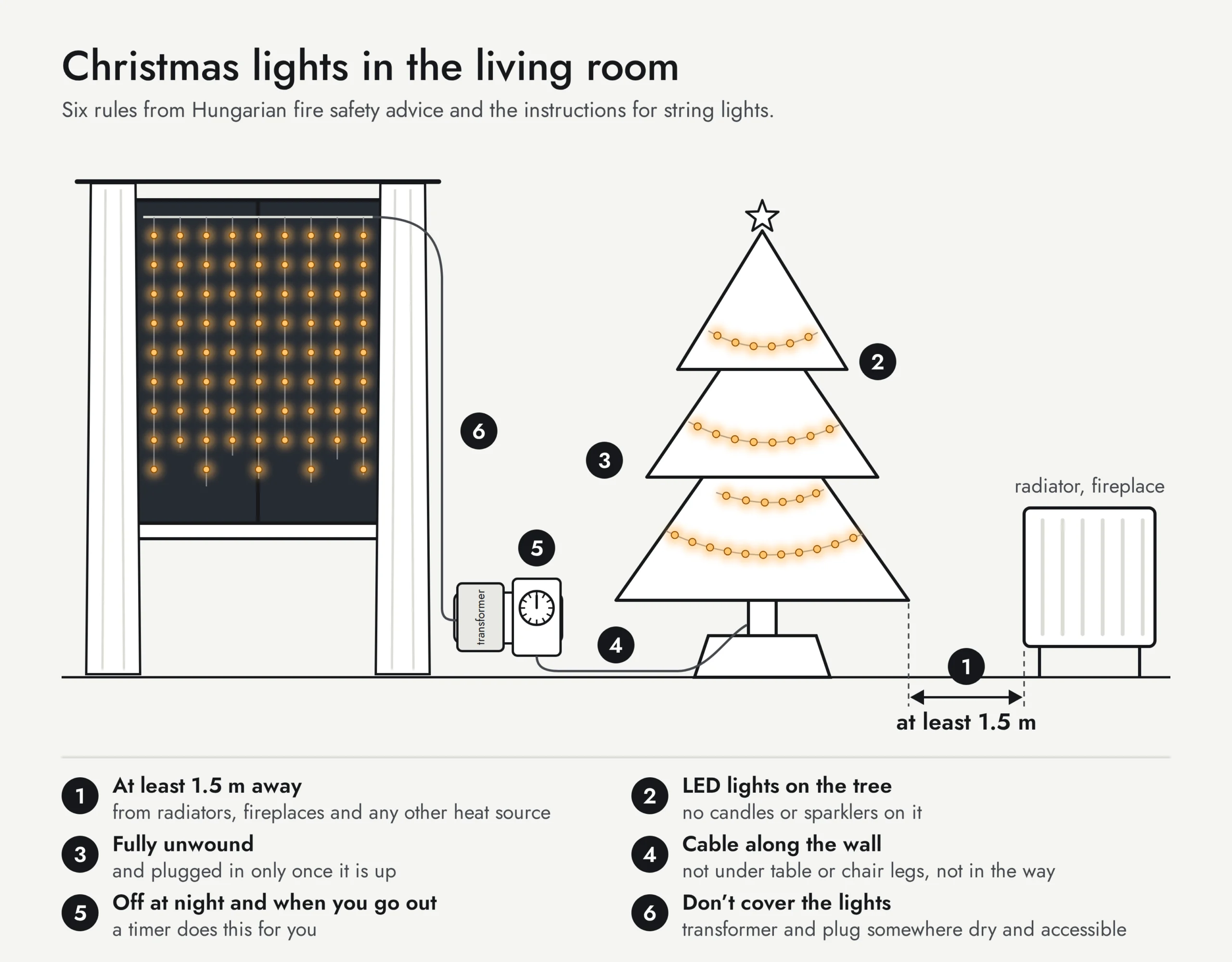
- Check the lights. Cracked insulation, a kinked cable, a loose lamp holder, a melted plug or extension lead: if you find any of these, don’t use them.
- Unwind them completely. According to the fire authority, a string switched on while still coiled up gets hot and may sooner or later catch fire. Unwind the whole string even if it is longer than you need. Only try it out once it is out of the packaging.
- Put them up, then plug them in. Wrap them loosely around the branches; don’t pull them tight. No candles or sparklers on the tree.
- Route the cable. Run it along the wall, not under table or chair legs, and keep it out of the way so no one trips over it.
- Unplug them at night. And when you go out. A timer does this for you.
A cut tree becomes more flammable every day in a warm room. According to the fire authority, a dried-out tree can burn down completely in just twenty seconds — the longer the tree stands, the more important it is that the lights are not left on unattended.
Safety note. If the plug, the transformer or the extension lead gets warm, is discoloured or smells, unplug it and stop using it. Don’t repair damaged string lights: according to manufacturers’ instructions the supply cable cannot be replaced, so the whole string has to be replaced. If the circuit breaker or the RCD trips, don’t keep switching it back on; find the cause, or call a qualified electrician. According to the fire authority, one of the best means of prevention is a smoke alarm, fitted on the ceiling in the middle of the room.
Battery, USB or solar string lights: which one when?
Battery string lights are good where there is no socket: on a wreath, a shelf, in a jar, on a window decoration. USB lights run from a charger or a power bank. Solar lights are for outdoors, and in winter they only work reliably in a sunny spot with no shade. All three run at extra-low voltage; there is no mains voltage in the string.
- Battery: many battery string lights and tea lights have a built-in timer that keeps them on for about 6 hours after you switch them on, then off for 18 hours, and starts again at the same time the next day. If you won’t use them for a while, take the batteries out so they don’t leak.
- USB: runs on 5 V. The string is extra-low voltage, but a mains USB charger is a 230 V appliance: it should be undamaged and properly marked, and kept away from damp. Only use it outdoors if the instructions expressly allow it.
- Solar: charges its battery during the day and switches on by itself at dusk. According to the instructions for one esotec solar string, the panel must face south in a spot with no shade, the string cannot be used on a north-facing side, the panel has to be kept free of snow in winter, and you should expect shorter lighting times.
Another manufacturer’s instructions ask for at least 6 hours of direct sunshine on the panel, and warn that light from a street lamp can stop the string from switching on. On short, often overcast December days, solar string lights are therefore the least predictable Christmas lights.
Battery and USB string lights need a CE marking too, just not under the Low Voltage Directive: Directive 2014/35/EU covers voltages between 50 and 1000 V AC and between 75 and 1500 V DC. It does, however, apply to the mains charger and the transformer.
What should you look out for with outdoor Christmas lights?
Only put outdoor string lights outside: according to the fire authority, indoors it doesn’t matter which kind you use, but outside you should only decorate with outdoor lights. The usual rating for outdoor string lights is IP44, which means protection against water splashing from any direction: they can cope with rain and snow, but not with puddles or water jets.
- Extra-low voltage: on the house and in the garden, string lights with a transformer, for example 24 or 31 V, are the safer choice, because 230 V only goes as far as the transformer. Use the transformer only with the string it came with, and don’t lay it on the ground.
- Socket: a covered outdoor socket rated at least IP44, protected by a 30 mA residual current device (RCD). The standard HD 60364-4-41 requires this as additional protection for general-purpose socket-outlets and for mobile equipment used outdoors, up to 32 A.
- Extension lead: an outdoor cable with rubber insulation and a rubber sheath, for example one marked H07RN-F. According to Lapp’s datasheet, this is made for heavy mechanical stress and is also suitable for outdoor use.
- Cable reel: unwind it completely. One 25-metre, IP44 cable reel from BGS technic can take a maximum load of 1000 W when wound up and 3500 W when fully unwound; the limits for your own reel are on its label.
- Connections: lift the plug, the connections and the multi-way adaptor off the ground, and put them under cover where water and snow cannot settle on them.
Our article on outdoor string lights covers fixing, connecting sets and snow in detail, and our article on IP ratings explains the two digits of the IP code.
Call a qualified electrician if there is no outdoor socket, if you don’t know whether it is protected by a 30 mA RCD, if the RCD trips again and again in the rain, or if you want permanently wired decorative lighting that stays outside all year. Connecting to the mains is not a DIY job.
How do you put Christmas lights on a timer?
The simplest option is the string’s own timer. The transformer of one 31 V Globus outdoor string switches on for 6 hours and then off for 18: if you press the button at 5 pm, the lights come on every day from about 5 pm to 11 pm. The same transformer also lets you set the brightness: 100, 75, 50 and 25 per cent.
- Plug-in timer: goes between the socket and the plug, and switches at the times you set. Outdoors you need an outdoor version rated at least IP44; its maximum load is marked on the housing.
- Dusk-to-dawn sensor: switches on when it gets dark. Some outdoor string lights have one built in, and solar lights typically work this way. Our article on motion sensors and dusk-to-dawn sensors explains how to adjust a hard-wired one (LUX, TIME); wiring it in is a job for a qualified electrician.
- Smart plug: switches on a schedule or from your phone, and lets you check remotely whether the lights have gone off.
A timer does not just save electricity: the lights go off by themselves at night, just as the fire authority asks.
Warm white or cool white string lights?
For the home, warm white (around 2700 K) or extra warm, amber string lights (around 2200 K) are the usual choice: they come closest to candlelight and to old incandescent bulbs. Cool white (above 5000 K) has a bluish, icy effect; don’t mix it with warm white in the same space, because the two whites clash.
Outdoors, too, warmer light is the gentler choice: it contains less blue, and causes less light pollution. Our article on colour temperature shows the kelvin scale in pictures, and you can try out the difference with the light colour simulator.
Frequently asked questions
Can I leave Christmas lights on overnight?
It is best not to. The Hungarian fire authority asks people to unplug the Christmas tree lights at night, and to switch them off when they go out as well. A string’s built-in timer or a plug-in timer takes care of this for you.
Can I put indoor fairy lights on the balcony?
No. Indoor string lights are typically IP20 and not protected against water; even on a covered balcony they are exposed to condensation, dew and wind-blown rain. Only put string lights outside if the packaging and the instructions expressly allow outdoor use.
Can I connect two strings of lights together?
Only if the manufacturer expressly allows it, and only as many as the instructions or the transformer state. Several manufacturers’ instructions say the string must not be connected to any other string. In the NKFH’s survey, failing to state the maximum number of strings that can be connected also counted as a defect.
How long do solar string lights stay on in winter?
That depends on the location and the weather. One 100-LED esotec string lights for up to 10 hours on a fully charged battery, but even the manufacturer says to expect less in winter. If it barely lights up after a few overcast days, some manufacturers suggest switching it off for a day or two while the battery charges; the instructions will tell you whether your string charges while switched off.
Sources
- Hungarian National Directorate General for Disaster Management (BM OKF): Safe holidays – fire safety advice for Advent (26 November 2025) and A dried-out Christmas tree is extremely flammable (Vas County directorate, 5 January 2024), both in Hungarian.
- Hungarian National Trade and Consumer Protection Authority (NKFH): NKFH tested string lights and Christmas decorations – 56 of 58 products posed a risk of electric shock (23 December 2025, in Hungarian).
- MVM Next: Electricity prices in the universal service for residential customers (PDF) and prices page, both in Hungarian — A1 tariff, 2,523 kWh/year threshold.
- Legislation and standards: Directive 2014/35/EU (Low Voltage Directive), EUR-Lex; catalogue entries of the Hungarian Standards Institution (MSZT) for the Hungarian editions, in Hungarian: MSZ EN IEC 60598-2-20:2024 (lighting chains), MSZ HD 60364-4-41:2018 (protection against electric shock).
- Manufacturers’ data for string lights: Konstsmide 2010-000, 2037-010EE and 1144-000EE (consumption per 1000 hours); instructions for Globus 240-LED and 750-LED outdoor strings (PDF, in German).
- Manufacturers’ data for accessories: Lapp H07RN-F datasheet (PDF); instructions for the BGS technic 3375 cable reel (PDF, in German); instructions for the esotec 102102 solar string and instructions for a Globus solar string (PDF, in German).