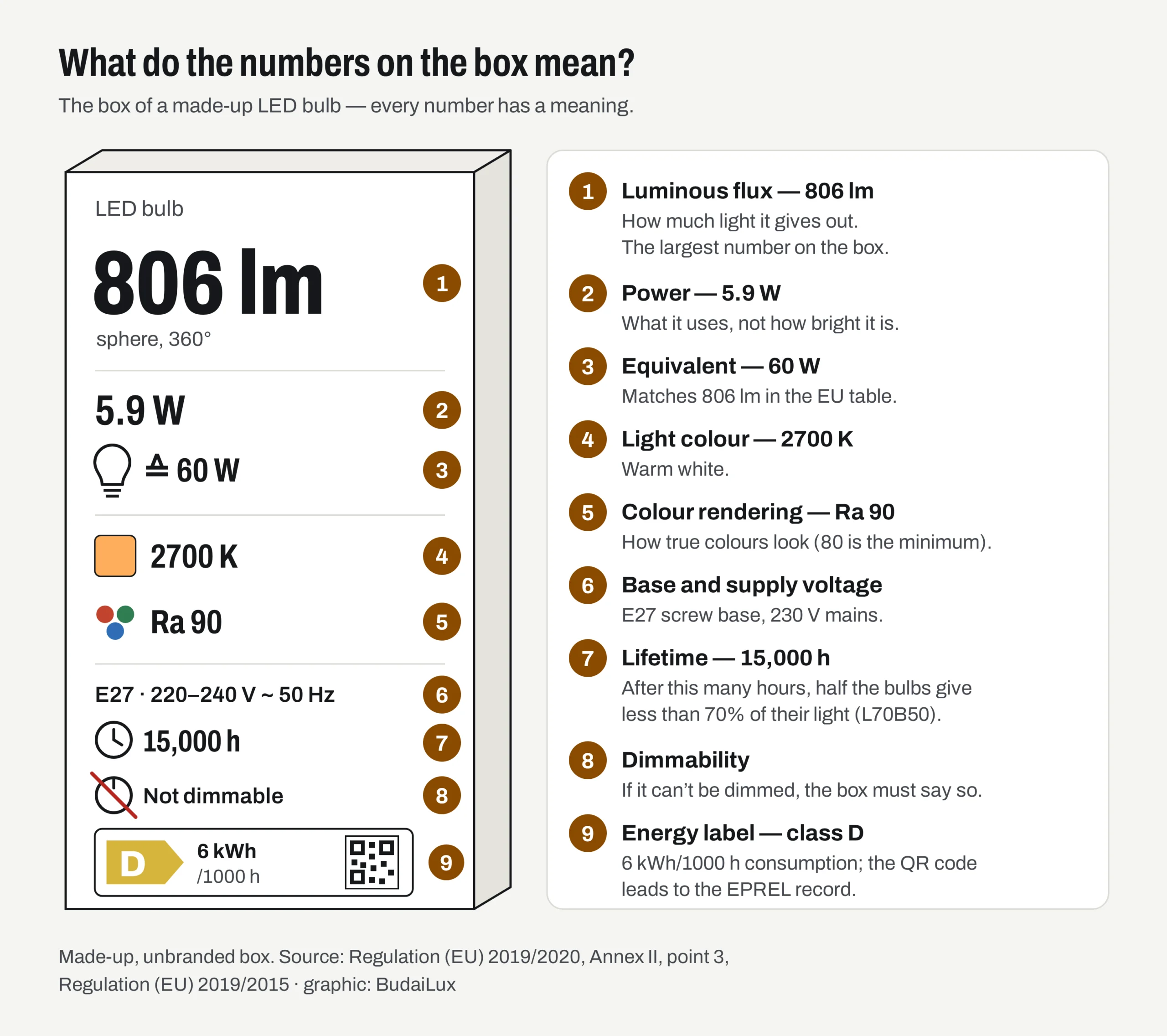
The box of an LED bulb carries a dozen numbers: 806 lm, 5.9 W, “equivalent to 60 W”, 2700 K, Ra 90, 15,000 h, plus a letter on the energy label. Most of them are required by EU regulation, and each one says something different: lumens tell you how much light, watts how much electricity, kelvin what colour the light is.
Below we go through what each number means, how lumens differ from lux, how many watts you need for 1000 lumens, and when “equivalent to 60 W” is actually true. To work out how much light a room needs, use our lumen calculator.
What is a lumen?
The lumen (lm) is the unit of luminous flux: the total amount of visible light a light source gives out. The higher the number, the more light. The watt (W) measures consumption: an 806-lumen LED bulb draws 6–10 W, and under the EU table it is equivalent to a 60 W incandescent bulb.
The EU definition says luminous flux is the quantity, expressed in lumens, derived from radiant power by taking into account the sensitivity of the human eye, and it covers all the light leaving the source in every direction (Regulation (EU) 2019/2020, Article 2). So a lumen is not simply energy but “seen” light: the eye is most sensitive to yellowish-green.
The lumen is a derived SI unit: 1 lm = 1 cd · sr, one candela of luminous intensity within one steradian of solid angle (BIPM, SI Brochure). For everyday purposes, all you need to remember is that lumens are all the light coming out of the lamp.
Luminous flux has to be the most prominent figure on the box. The regulation requires it in characters at least twice as large as the power in watts, together with whether the figure refers to a sphere (360°), a wide cone (120°) or a narrow cone (90°). The sphere is for bulbs that shine all round, the cone for spotlights: for a spot, only the useful light going forwards is counted.
What is the difference between lumens and lux?
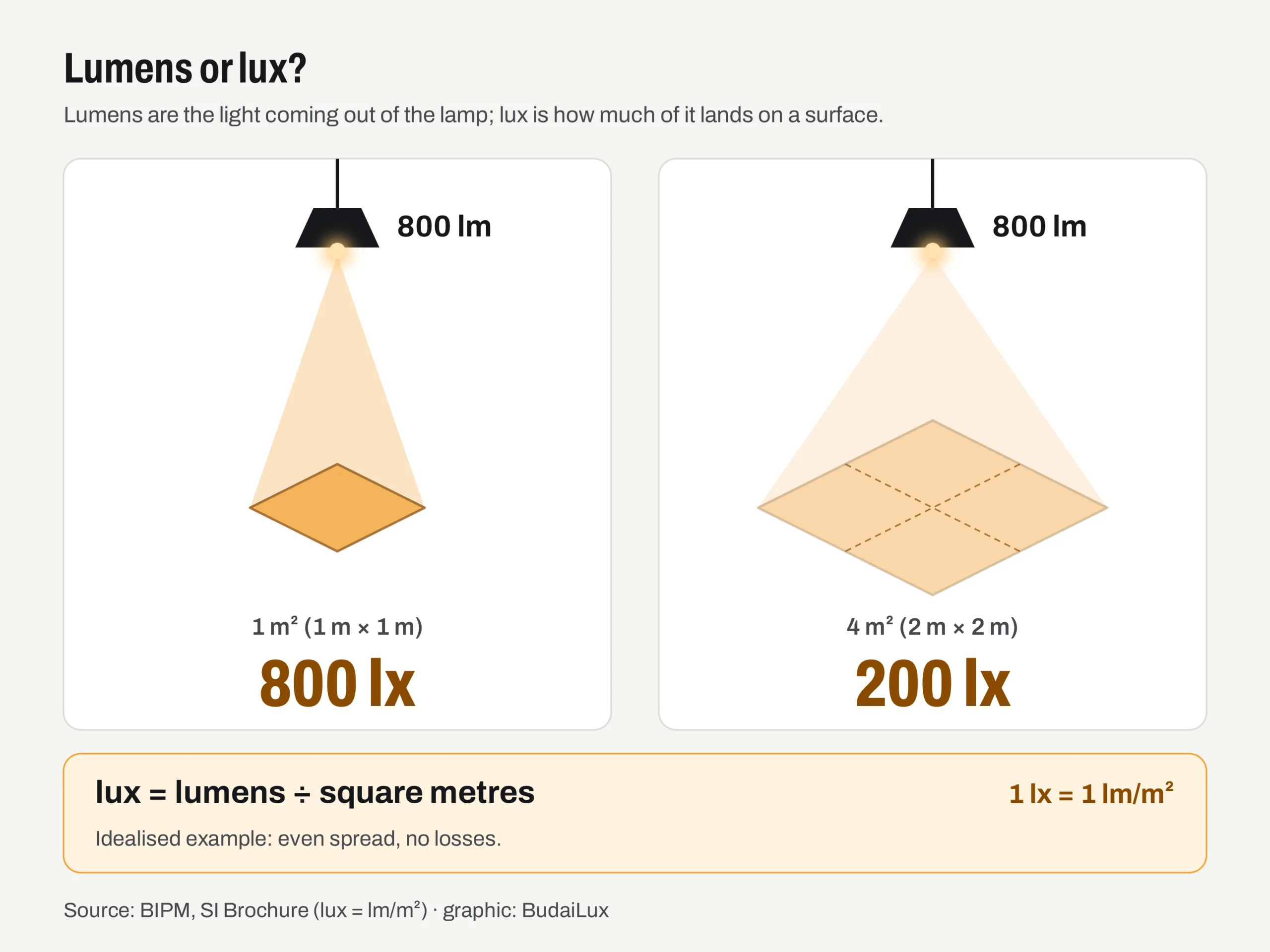
Lumens tell you how much light comes out of the lamp; lux (lx) tells you how much of it reaches a surface. 1 lux = 1 lumen per square metre. The same lamp gives a lot of lux on a small table and little when the light is spread across a large room.
A simple example: if all the light from an 800-lumen lamp fell evenly on 1 m², that would be 800 lux. Spread over 4 m², the same light gives 200 lux. In reality, some of the light lands on the walls and ceiling and is partly absorbed there, so lighting design allows for more lumens than this.
Lux is what you actually “see” on a work surface, so lighting design sets its target in lux and works back to the lumens required. Our lumen calculator, for example, uses 150 lux for general lighting in a living room and 300 lux in a kitchen, with a separate 500 lux for the worktop.
The beam angle of a spotlight affects lux too: the same luminous flux squeezed into a narrower cone lands on a smaller spot, so it gives more lux there. That is why a 36° spot looks “brighter” than a 60° one with the same lumens.
How many watts is 1000 lumens?
With today’s LEDs, typically 8–13 W; for an incandescent bulb, the EU equivalence table gives roughly 72 W. There is no fixed lumens-to-watts conversion, because watts measure consumption and lumens measure light. The link between them is luminous efficacy, given in lumens per watt (lm/W): the higher it is, the less electricity it takes to make the same light.
The 8–13 W comes from the 80–130 lm/W LED range our calculator uses (1000 ÷ 130 ≈ 7.7; 1000 ÷ 80 = 12.5). The best LED bulbs today do even better: the datasheet for a 4 W, 840-lumen Signify bulb states 210 lm/W, so 1000 lumens would need about 5 W. An incandescent bulb managed about 12 lm/W: a 60 W one gave about 730 lumens.
The 72 W comes from the EU equivalence table: 806 lm corresponds to a 60 W bulb and 1055 lm to a 75 W one, and values in between are calculated proportionally. So 1000 lm is 60 + (1000 − 806) ÷ (1055 − 806) × 15 ≈ 72 W.
There is a theoretical ceiling, too. The SI defines the candela so that 1 W of radiant power at a green frequency of 540 THz equals 683 lumens. That holds for one colour only; white light achieves far less.
| Old bulb | Lumens needed to say “equivalent to … W” | Today’s LED, approx. (80–130 lm/W) |
|---|---|---|
| 15 W | 136 lm | 1–2 W |
| 25 W | 249 lm | 2–3 W |
| 40 W | 470 lm | 4–6 W |
| 60 W | 806 lm | 6–10 W |
| 75 W | 1055 lm | 8–13 W |
| 100 W | 1521 lm | 12–19 W |
| 150 W | 2452 lm | 19–31 W |
| 200 W | 3452 lm | 27–43 W |
If you are starting from the wattage of your old bulb, the bulb replacement helper below works out the LED equivalent and the running cost. Its table uses the typical output of old bulbs (60 W ≈ 730 lm), so it shows slightly lower lumens than the EU threshold above.
Bulb replacement helper
Watts measure consumption, not light. If you start from the wattage of the old bulb, it is easy to get it wrong — this table tells you the real equivalent based on luminous flux.
Conversion table
| Old bulb | Luminous flux | LED equivalent |
|---|---|---|
| 25 W | ~230 lm | 2–3 W |
| 40 W | ~430 lm | 4–6 W |
| 60 W | ~730 lm | 6–10 W |
| 75 W | ~950 lm | 8–12 W |
| 100 W | ~1,350 lm | 11–17 W |
| 150 W | ~2,200 lm | 17–28 W |
What to watch out for when swapping: the maximum wattage marked on the light fitting refers to incandescent bulbs — with LED it is practically never the limit. What does matter is the colour temperature (2,700–3,000 K at home), the colour rendering (CRI above 90), and whether it is dimmable if it goes on a dimmer. Not every LED is, and a non-dimmable LED on a dimmer flickers or fails.
What does “equivalent to 60 W” mean?
It means the light source’s luminous flux matches that of a 60 W incandescent bulb under the EU table: 806 lumens. This is not a claim manufacturers can make freely. Under Regulation (EU) 2019/2015, for a light source that shines all round, the equivalent wattage has to be the table value for its luminous flux; values in between are interpolated and rounded to the nearest whole watt.
The table values are somewhat higher than what old bulbs typically gave (806 lm at 60 W instead of the usual 730 or so), so an LED correctly labelled “equivalent to 60 W” gives no less light than the bulb it replaces. For spotlights, i.e. directional light sources, there are reference values per type and correction factors.
What do kelvin and the Ra value tell you?
Kelvin (K) gives the colour temperature of the light: the lower the number, the warmer and yellower it is. For homes, 2700–3000 K is usually the right choice; for worktops and mirrors, 3000–4000 K. The box must show it rounded to the nearest 100 K, or the adjustable range for tunable lights. You can see the difference for yourself with the light colour simulator.
Ra (CRI, colour rendering index) measures how faithfully the colours of objects appear under the light, on a scale up to 100. The EU requires at least Ra 80 for most light sources, and the value has to appear on the box rounded to a whole number. For kitchens, dining areas and mirrors, Ra 90 or higher is recommended. Ra is the average of eight test colours; the R9 value for saturated red is on the product’s EPREL record.
What do beam angle, lifetime and switching cycles mean?
The beam angle must be stated for spotlights. It is the angle of the cone at whose edge the luminous intensity drops to half the central value. A smaller angle gives a narrower, stronger spot of light; for a bulb that shines all round it is irrelevant.
For LEDs, lifetime is shown in hours as an L70B50 value: after that many hours of use, half of the light sources give less than 70% of their initial luminous flux. So it is not when the bulb burns out, but when half of them have become noticeably dimmer. At 3 hours a day, 15,000 hours is about 13.7 years.
The number of switching cycles — how many times it can be switched on and off — is not mandatory on the box today, but many manufacturers state it: the Signify bulb mentioned above gives 500,000, for example. Market surveillance testing also switches lamps on and off: LED light sources are run for 1,200 cycles of 150 minutes on and 30 minutes off, and at least 9 of the 10 units tested must still work afterwards.
The box also shows the electrical connection: the base (for example E27) and the voltage (230 V AC or 12 V DC).
How can you tell whether a light source is dimmable?
From the box. Regulation (EU) 2019/2020 requires a warning if the light source cannot be dimmed, or can only be dimmed with certain dimmers; in the latter case the manufacturer has to publish a list of compatible dimmers on its website. A non-dimmable LED on a dimmer may flicker or fail.
How do you read the energy label?
Since 1 September 2021, the energy label for light sources has used an A to G scale; the old A+ and A++ classes are gone. The class depends on luminous efficacy: useful luminous flux divided by power, with no correction factor for non-directional mains light sources. Class A needs at least 210 lm/W; B starts at 185, C at 160, D at 135, E at 110 and F at 85 lm/W, with G below that.
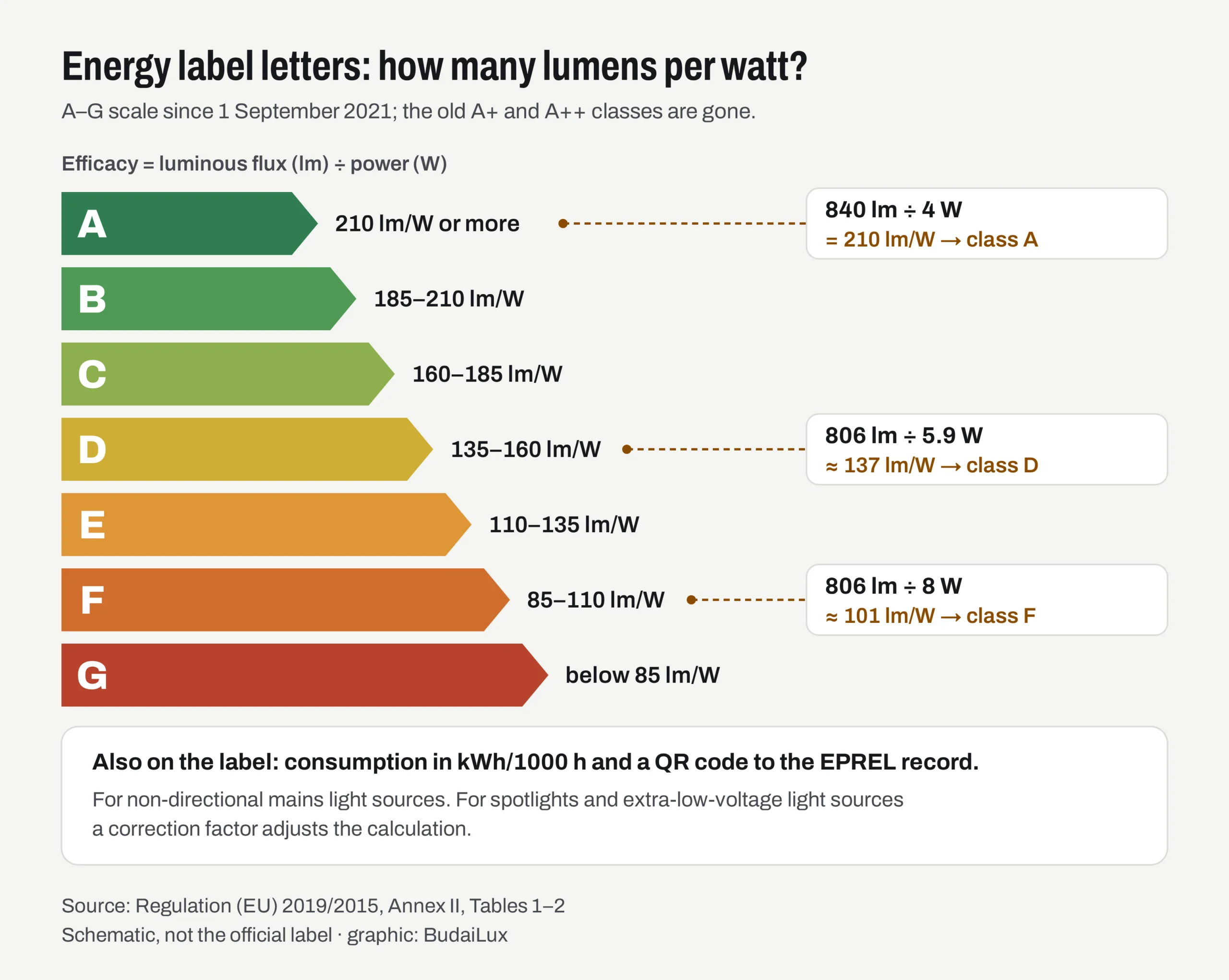
An example: an 806-lumen, 5.9 W bulb at 137 lm/W falls into class D; an 8 W bulb with the same light, at 101 lm/W, into class F. So the letter shows efficiency, not quality: even a class F LED uses a fraction of the electricity of an incandescent bulb with similar light.
The label also shows consumption per 1000 hours of use, in kWh, rounded up to a whole number (5.9 W → 6 kWh/1000 h). The QR code leads to the product’s record in the EU EPREL database. That is where you will find details that are often not on the box: flicker (Pst LM) and stroboscopic effect (SVM) values, R9, colour consistency and whether it is dimmable.
A light fitting’s box usually carries no label: if the light source can be removed, the instructions must state the energy class of the light source it contains. We cover this and the other mandatory markings on lights in our article on CE marking. An LED strip, on the other hand, is itself a light source, so its box does carry the label.
Frequently asked questions
How many lumens is a 60 W bulb?
Under the EU equivalence table, 806 lumens: that is what an LED needs to be labelled “equivalent to 60 W”. An old 60 W incandescent bulb actually gave about 730 lumens, so a correctly labelled LED gives at least as much light.
How much is 1 lux?
One lumen of light spread evenly over one square metre. For reference, our lumen calculator uses 150 lux for general lighting in a living room and 500 lux for a kitchen worktop.
Do more watts mean brighter light?
Not necessarily with LEDs. Two LEDs of the same wattage can differ a lot in light output, because their efficacy differs. When buying, look at the lumens; the watts tell you the consumption.
Can I trust the lumen value on the box?
The authorities can check it: they test 10 units, and the measured useful luminous flux may fall short of the declared value by no more than 10%. If in doubt, scan the QR code on the label: the EPREL record shows the data registered for that model, which you can compare with the box.
Sources
- Commission Regulation (EU) 2019/2020 laying down ecodesign requirements for light sources, consolidated version (1 September 2021), EUR-Lex — Article 2 and Annex I: luminous flux, beam angle, lifetime; Annex II, points 2–3: Ra ≥ 80 and the details required on the packaging; Annexes IV–V: verification tolerances, endurance testing.
- Commission Delegated Regulation (EU) 2019/2015 on the energy labelling of light sources, consolidated version, EUR-Lex — Annex II: energy efficiency classes; Annex III: label content; Annex V, Table 7: equivalence claims.
- BIPM: The International System of Units (SI Brochure) — definitions of the lumen and the lux, and of the candela (683 lm/W at 540 THz).
- European Commission: EPREL — European Product Registry for Energy Labelling, the public database of products with an energy label.
- Signify (Philips): MASTER LEDbulb 4-60W E27 827 A60 datasheet (May 2026) — 840 lm, 4 W, 210 lm/W, class A, 500,000 switching cycles, Pst LM 1, SVM 0.4.