Every Advent, outdoor string lights come out in many homes, and with them the same questions: will they survive rain and snow, how many sets can be connected together, and how do you fix them up without damaging the cable? The box almost always says IP44 — but that is only half the story.
String lights rarely fail where the IP44 label is. The weak points are usually the transformer, the plug, the connections and the socket. This article goes through the whole chain, from the wall socket to the end cap.
Is IP44 enough for outdoor string lights?
For the string itself, usually yes: IP44 protects against water splashing from any direction, so it can cope with rain and snow. It does not protect against water jets, puddles or immersion, and it only applies to the string. The transformer, the connections and the socket each need their own protection.
Our article on IP ratings explains the two digits of the IP code in detail. In short: the first 4 means that solid objects larger than 1 mm (wire, insects) cannot get in, and the second 4 that splashing water does no harm. The classification is defined in the standard EN 60529.
String lights also have their own product standard: EN IEC 60598-2-20 (Luminaires – Part 2-20: Particular requirements – Lighting chains). It covers indoor and outdoor lighting chains up to 250 V alike. In Hungary, the current edition has applied since 1 November 2024.
What does the IP44 rating on string lights not cover?
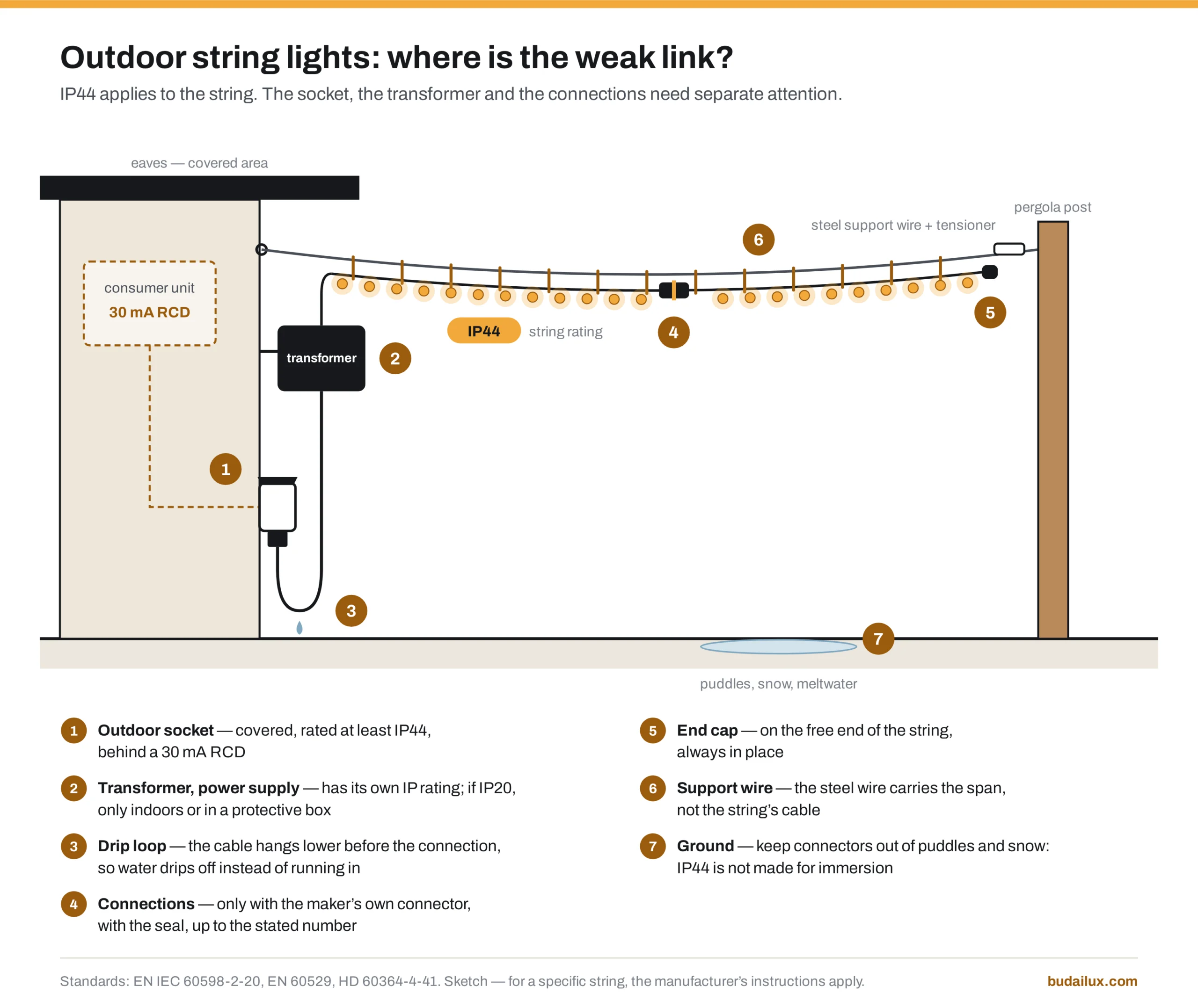
The IP44 on the box usually refers to the string, not automatically to the whole set. There are four places worth checking separately:
- The transformer or power supply. It has its own IP rating, which may be lower than the string’s. The manufacturer’s instructions for one outdoor extra-low-voltage string, for example, state that the string is IP44 (excluding the transformer), but the transformer is IP20, so outdoors it may only be used in a suitably protected outdoor socket or a weatherproof box.
- The socket and the plug. An ordinary indoor socket is not waterproof. Manufacturers’ instructions specify a protected socket rated at least IP44 for outdoor use.
- The connections and the end cap. A connector is only protected when it is plugged together, with its sealing ring. Unplugged, without the cap or with a missing seal, it is not.
- Water jets and standing water. Splashing water is not the same as a water jet (that needs IPX5) or immersion (IPX7). IP44 does not cover anything lying in a puddle, in snow or in meltwater.
That this is not a theoretical problem is shown by an official survey. In December 2025, Hungary’s National Trade and Consumer Protection Authority (NKFH) examined 58 different outdoor and indoor lighting chains and electrical Christmas decorations, and 56 of them proved dangerous. The defects included products not protected against water being recommended for outdoor use, and no maximum number of strings that may be connected together being given.
Where is IP44 enough, and where do you need more?
Even where they are exposed to rain, IP44 is the usual rating for outdoor string lights, and it is enough against splashing water. Where a water jet hits them, or water collects on them, you need a higher rating — or a better position.
| Where is it? | Is IP44 enough? | What to watch out for |
|---|---|---|
| Indoors, behind a window | There, even IP20 is enough | But don’t take an indoor IP20 string outside. |
| Covered terrace, porch, under the eaves | Yes | Condensation and wind-blown rain still reach it; keep the transformer under cover too. |
| In the open, exposed to rain: tree, shrub, fence | Yes, for the string | Keep the transformer, the connections and the multi-way adaptor off the ground. |
| Hit by a sprinkler, irrigation system or hose | No | Water jets need IPX5 (for example IP65) — or put it somewhere else. |
| Connector lying on the ground, in a puddle or under snow | No | Immersion would need IPX7 or IPX8; it is simpler to lift it up. |
| Outdoor socket | At least IP44 | A covered socket, behind a 30 mA RCD. |
Low-voltage or 230 V string lights: which is better outdoors?
Outdoors, extra-low-voltage string lights with a transformer are the safer choice. With these, 230 V only goes as far as the transformer, and the string itself runs at, say, 24 V or 31 V, so a damaged or wet section carries a far lower risk of electric shock than a 230 V string plugged straight into the socket.
| 230 V string | Extra-low-voltage string | |
|---|---|---|
| What is in the string? | mains voltage | for example 24 V or 31 V, after the transformer |
| If it is damaged or gets wet | risk of electric shock | a much lower risk, but the transformer and the plug are still 230 V |
| Transformer | none | use only the original one |
| Connecting sets | only if the manufacturer expressly allows it | within the system, up to the stated limit |
Use the transformer only with the string it came with — and vice versa. Manufacturers specifically require this: with a different power supply, or connected directly to the mains, the string can become an electric shock and fire hazard.
How many string lights can be connected together?
As many as the manufacturer states — no more, and none of a different make. You will find the maximum in the instructions or on the transformer, given as a number of sets, LEDs or watts. If the string has no output connector, or the instructions give no number, then none at all.
One manufacturer’s example: for one outdoor extra-low-voltage string, at most two sets (40 bulbs in total) can be connected, and the instructions say that exceeding the limit may make the product unsafe. For another system the number may be different. For strings that cannot be extended, manufacturers expressly forbid connecting them to another string.
- Only connect parts of the same system: same manufacturer, same voltage, same connector.
- Make sure the sealing ring is in place, and screw the connector together as far as it will go.
- Always put the end cap back on the free end.
- Don’t cut and rejoin the cable, and don’t try to make it waterproof with insulating tape.
- As an extension lead, use an outdoor rubber-insulated cable (for example one marked H07RN-F), lift the connection off the ground and keep it under cover.
Do outdoor string lights need an RCD?
Yes: the outdoor socket should be protected by a 30 mA residual current device (RCD). The standard for low-voltage electrical installations, HD 60364-4-41, requires this as additional protection for general-purpose socket-outlets and for mobile equipment used outdoors, up to 32 A.
In your consumer unit (fuse box), look for a device with a push button marked “T” or “TEST” and the rating 30 mA (0.03 A). If there isn’t one, or you don’t know which circuit it protects, ask a qualified electrician. A plug-in portable RCD can help in the meantime, but it is no substitute for a proper installation.
Safety note. Don’t repair string lights with damaged insulation, a cracked lamp holder or a melted plug: according to manufacturers’ instructions the supply cable cannot be replaced, so the whole string has to be replaced. Only buy products with proper markings (CE, IP number, manufacturer, instructions in your language) — in the NKFH survey in Hungary, missing Hungarian-language instructions also counted as a defect. For your own string lights, the manufacturer’s instructions always apply.
How do you fix string lights without damaging the cable?
The golden rule for fixing string lights: hold the cable, but don’t pinch it, pierce it or put it under load. Plastic clips, gutter clips or loosely tightened cable ties are fine; staples, nails, metal clips and wire wrapped round the cable are not.
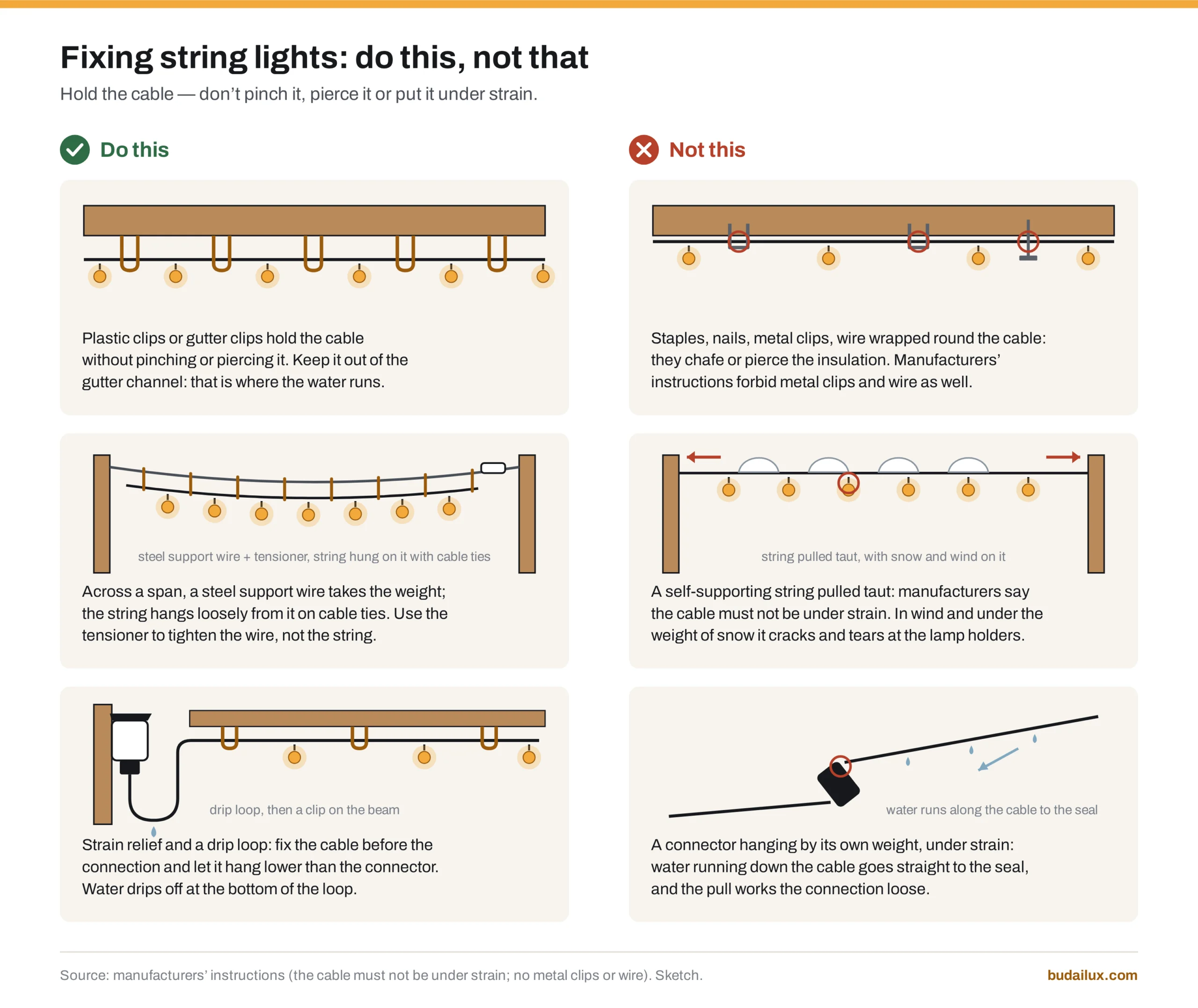
- Eaves, house front: gutter clips or plastic clips. Run the cable along the edge of the eaves, not in the gutter channel, where meltwater runs and ice freezes onto it.
- Railings, fences: cable ties, loosely, roughly every half metre — just enough to stop the wind whipping the string about.
- Trees, shrubs: wrap it loosely around the branches. The wind moves the branches, and every movement pulls a tightly wound string at the lamp holders.
- A span between a pergola and the house: stretch a steel support wire (a plastic-coated wire rope) with a tensioner, and hang the string from it with cable ties. That way the wire, not the string’s cable, takes the weight and the wind. Fix the string to the wire with plastic cable ties, not with wire.
- Connectors: fix the cable before the plug, the transformer and each connection, and leave a drip loop: the cable should hang lower than the connection, so water drips off instead of running into the seal. Mount the transformer upright, with the cable pointing down, and don’t lay it on the ground.
- Order: put everything up first, and only then plug it in. Only try it out once it is unpacked.
Manufacturers’ instructions sum this up in one sentence: once installed, the supply cable, the plug and the connecting cables must not be under strain and must not be twisted.
What should you do in snow, ice and wind?
Snow and rain falling on the string are not a problem in themselves for IP44 string lights. Trouble starts where water collects: at a connector, multi-way adaptor or transformer lying on the ground. Always lift these off the ground for the winter.
- Snow: the weight of a layer of snow and frozen-on ice pulls at the string. A string hung from a support wire copes with this better than one stretched taut. Don’t shake the snow off by pulling the string.
- Ice: don’t prise frozen-on ice off. In frost the plastic insulation is stiffer, so don’t bend or tug the string — if it has to come down, wait for milder weather.
- Wind: the wind whips loosely hanging sections about, and the cable can chafe at fixing points and on sharp edges (metal flashing, brick). Add more fixing points and route the cable around sharp edges.
How do you take down and store string lights?
Unplug it first — by the plug, not the cable — and only then undo the clips. Don’t pull the string off the eaves or the branches: yanking damages the cable at the lamp holders and the connections.
- If it is wet, let it dry before putting it away.
- Check it over: cracked insulation, a missing sealing ring, a loose lamp holder, a discoloured or melted plug. Don’t repair a damaged string; take it to an electrical waste collection point.
- Wind it loosely onto a piece of card or a cable reel; don’t ball it up.
- Store it somewhere cool, dry and away from light — as manufacturers’ instructions also ask.
- Put the transformer, the end caps, the spare seals and the instructions in the same box.
When should you call an electrician?
Putting up string lights is not a job for an electrician. In these cases, however, it is worth calling a qualified electrician:
- there is no outdoor socket, and you would like one;
- you don’t know whether the outdoor socket is protected by a 30 mA RCD;
- the RCD trips again and again, and you cannot find where the water is getting in;
- the plug, the socket or the transformer gets warm, smells or is discoloured;
- you want permanent, hard-wired decorative lighting — the string-light standard treats permanently installed lighting chains separately.
Frequently asked questions
What does the IP44 rating on string lights mean?
It means the string is protected against solid objects larger than 1 mm and against water splashing from any direction. It can be used in rain and snow, but it must not be exposed to water jets, puddles or immersion. The rating applies to the string; the transformer and the connectors have IP ratings of their own.
Can string lights stay outside all winter?
Yes, if they are made for outdoor use and the transformer, the connectors and the socket are suitable for outdoors as well. After snowfall and stormy weather, it is worth checking the connections and the fixings. For decorative lighting that stays outside all year, permanently installable systems are the right choice, not occasional string lights.
Can I use indoor string lights on a covered terrace?
No. Indoor string lights are typically IP20 and not protected against water — even on a covered terrace they are exposed to condensation, dew and wind-blown rain. Only put string lights outside if the packaging and the instructions expressly allow outdoor use.
Can I run an extension lead out through a window?
It is best not to. A closing window or door pinches and kinks the cable, and water gets in through the gap. A covered outdoor socket is a better solution; if you don’t have one, a qualified electrician can install it.
Why does the RCD trip when it rains?
Because it detects leakage current, usually at a wet connector, connection or multi-way adaptor lying on the ground — the RCD is simply doing its job. Unplug the string, find the wet spot and dry it out, replace any damaged part, and don’t keep switching the RCD back on.
Sources
- Hungarian National Trade and Consumer Protection Authority (NKFH): NKFH tested string lights and Christmas decorations – 56 of 58 products posed a risk of electric shock (23 December 2025, in Hungarian)
- Hungarian Standards Institution (MSZT), catalogue entries for the Hungarian editions of the standards (in Hungarian): MSZ EN IEC 60598-2-20:2024 (lighting chains), MSZ EN 60529:2015 (IP code), MSZ HD 60364-4-41:2018 (protection against electric shock)
- Integral LED: installation guide for the ILDEL081 outdoor extra-low-voltage string (PDF) — IP44 string, IP20 transformer, at most two sets connected together
- Globus: instructions for a 750-LED, 31 V outdoor string (PDF, in German) — fixing, keeping the cable free of strain, IP44 socket, storage