Three questions about a living room chandelier are settled before you buy it: how big it should be, how high it should hang and how much light it should give. All three have a numerical answer, and none of them is a matter of taste. Taste comes in with the style — but if the size or the height is wrong, even the most beautiful chandelier gets lost in the room, or someone walks into it.
Below we go through the sizing formula, the rule for hanging height and the luminous flux you need, with example tables. The numbers come from the same model that the chandelier size calculator in this article uses, so you can try them out on your own room.
What size of chandelier does a living room need?
Rule of thumb: add the length and width of the room in metres and multiply by 8 — that gives the chandelier’s diameter in centimetres. A 4 × 5 metre living room therefore suits a chandelier of about 70 cm, although anything from 65 to 80 cm also works. Over a dining table, it is the width of the table that counts, not the room.
The formula is a design rule of thumb, not a standard: it gives the proportion for a chandelier intended for the centre of the room. The multiplier can range from 7 to 9. The lower value gives a more restrained effect, the higher one a bolder effect; in a living room with a high ceiling or little furniture the upper value works better, in a crowded or low room the lower one.
| Room | Floor area | Chandelier diameter | Total luminous flux for the living room | Of which ambient light (the chandelier) |
|---|---|---|---|---|
| 3.5 × 4.0 m | 14 m² | 60 cm (55–70 cm) | 2,300 lm | approx. 1,250 lm |
| 4.0 × 5.0 m | 20 m² | 70 cm (65–80 cm) | 3,300 lm | approx. 1,800 lm |
| 4.5 × 5.5 m | 24.75 m² | 80 cm (70–90 cm) | 4,100 lm | approx. 2,250 lm |
| 5.0 × 6.0 m | 30 m² | 90 cm (75–100 cm) | 4,950 lm | approx. 2,700 lm |
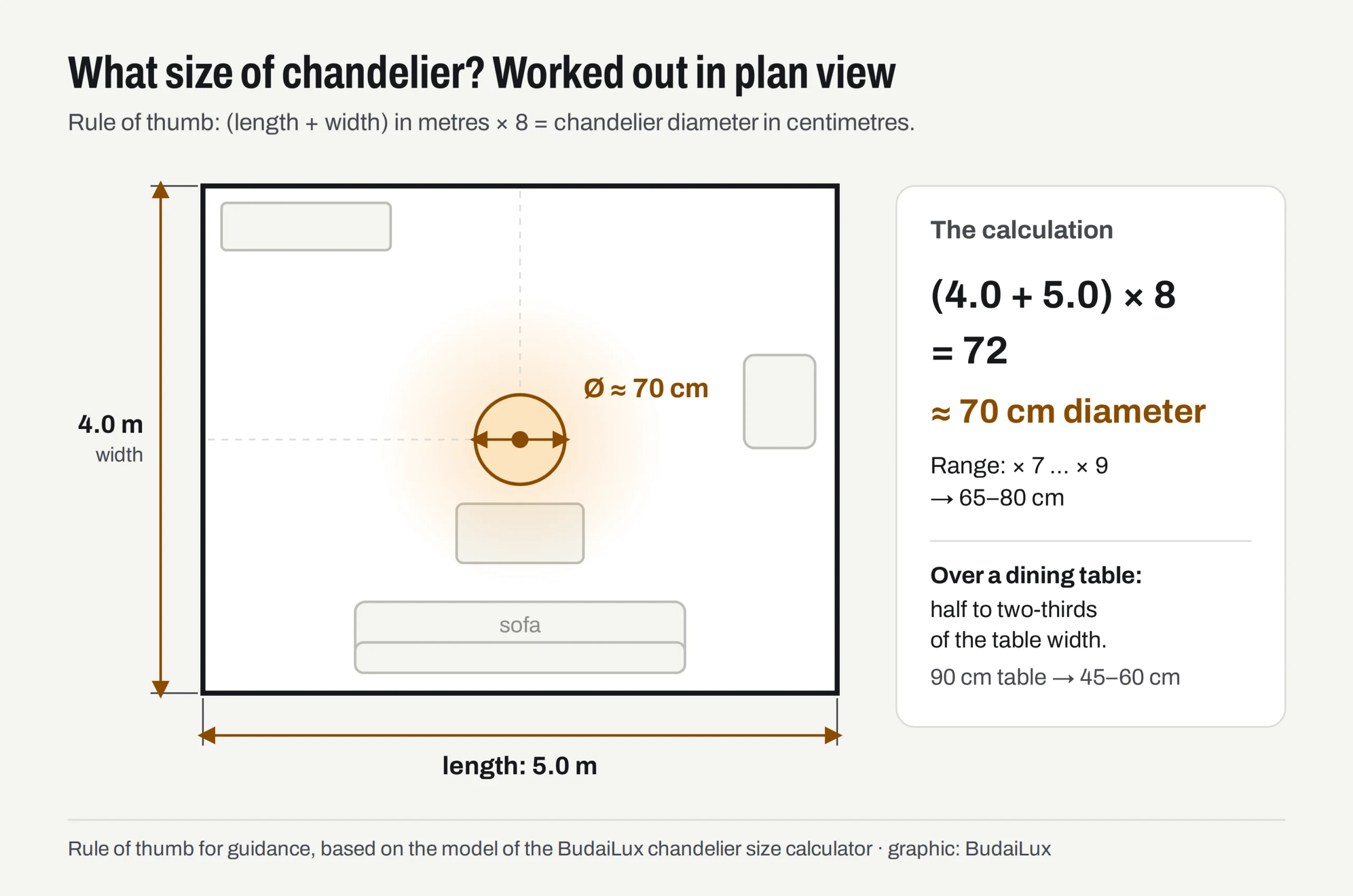
If the living room also has a dining table and the chandelier goes above it, the width of the table matters rather than the size of the room: the light’s diameter should be roughly half to two-thirds of the table’s width. A 90 cm wide table therefore suits a 45–60 cm light — much smaller than the size of the room would suggest.
Chandelier size calculator
Chandelier size is a question of proportion, not taste. There are two separate cases: in the middle of a room, the light should match the room's proportions; above a dining table, it should match the table — and the two often give very different sizes.
Centre of the room — sizing table
| Room | Recommended diameter | Range |
|---|---|---|
| 3,0 × 3,5 m | 50 cm | 45–60 cm |
| 3,5 × 4,0 m | 60 cm | 55–70 cm |
| 4,0 × 4,5 m | 70 cm | 60–75 cm |
| 4,0 × 5,0 m | 70 cm | 65–80 cm |
| 4,5 × 5,5 m | 80 cm | 70–90 cm |
| 5,0 × 6,0 m | 90 cm | 75–100 cm |
Above a dining table
| Table width | Light diameter | Height above the table top |
|---|---|---|
| 80 cm | 40–55 cm | 70–85 cm |
| 90 cm | 45–60 cm | 70–85 cm |
| 100 cm | 50–65 cm | 70–85 cm |
| 110 cm | 55–75 cm | 70–85 cm |
| 120 cm | 60–80 cm | 70–85 cm |
Two common mistakes: the first is choosing the light above the dining table by room size — that is how a 4×5 m room ends up with a 70 cm chandelier above a 90 cm table, which is out of all proportion. The second is measuring the hanging height from the floor even above a table; there, the right reference is the table top.
How high should a chandelier hang in a living room?
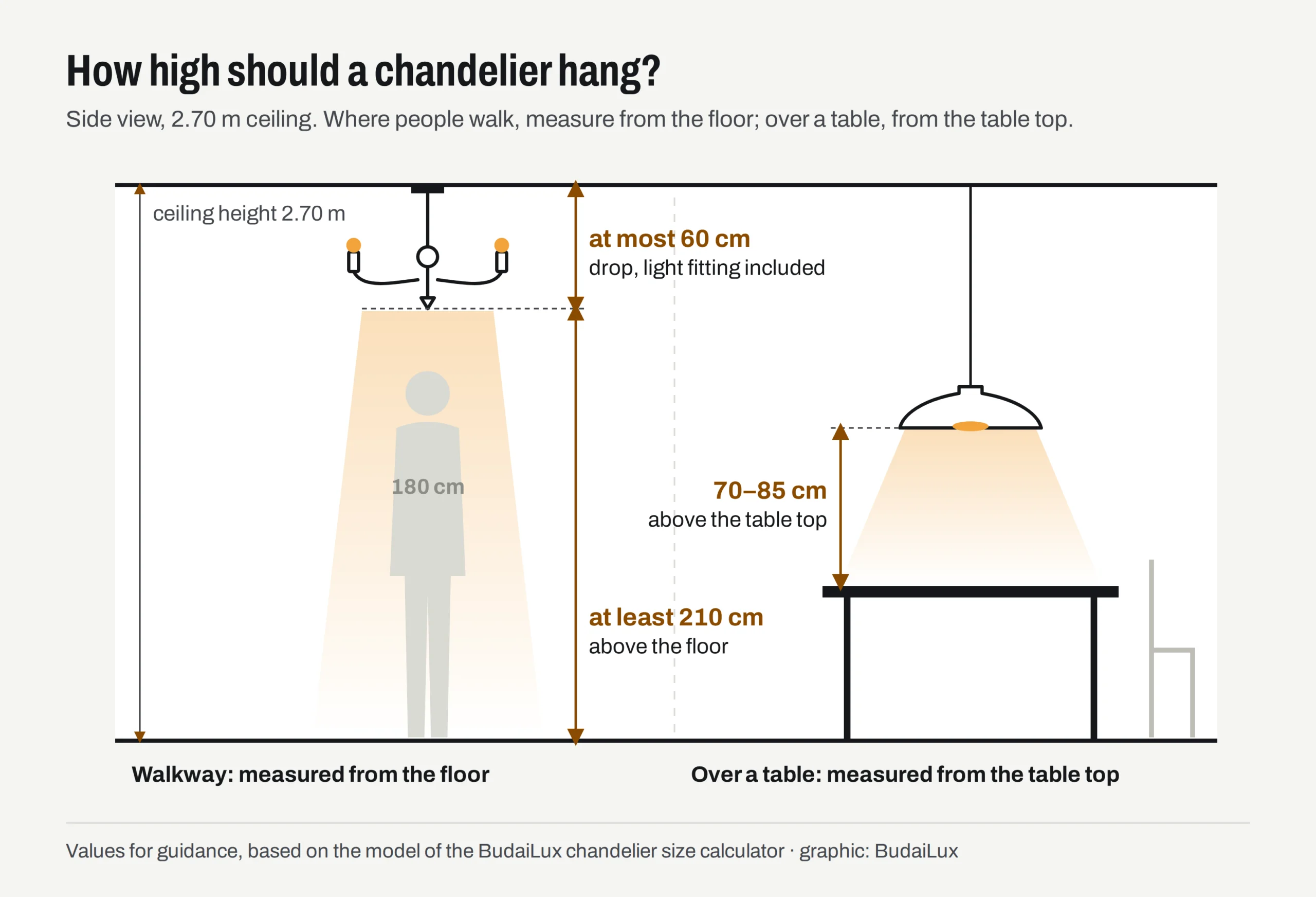
Where people walk underneath it, the lowest point of the chandelier should be at least 210 cm above the floor. From this it is easy to work out the maximum drop: subtract 210 cm from the ceiling height. The “drop” is the full length from the ceiling to the lowest point of the light, including the light fitting itself and any hanging crystals — not just the chain or the cable.
In a living room with a 2.7 metre ceiling, the chandelier can therefore hang down by at most 60 cm, and that includes the height of the light itself: a chandelier 40 cm tall leaves at most 20 cm for the suspension. Above a dining table the measure is different: you measure not from the floor but from the table top, and the bottom of the light should be roughly 70–85 cm above it. With a higher ceiling, the calculator suggests a slightly greater distance.
Chandelier or ceiling light for a low ceiling?
If the ceiling height is below 2.3 metres, there is no room for a hanging chandelier: a flush ceiling light is the right choice there. With a 2.4–2.5 metre ceiling, a flat, semi-flush chandelier or a short suspension works. A classic chandelier on a chain starts to fit comfortably at around 2.7 metres.
| Ceiling height | Maximum drop | What to choose |
|---|---|---|
| below 2.3 m | less than 20 cm | Flush ceiling light |
| 2.4 m | 30 cm | Flat, semi-flush chandelier |
| 2.5 m | 40 cm | Chandelier on a short suspension |
| 2.7 m | 60 cm | Classic chandelier on a short chain |
| 3.0 m | 90 cm | Larger, multi-tier chandelier |
| 3.5 m | 140 cm | Long suspension, tiered chandelier |
A ceiling light isn’t a worse choice for a living room, just a different one: all of its light stays close to the ceiling, so it gives more even but flatter light. If there is only one lighting point in the ceiling and the ceiling is low, a ceiling light needs a floor lamp and a table lamp alongside it to give the room some depth.
With a high ceiling, over 3 metres, the problem is the reverse: a chandelier on too short a suspension gets lost up high, and the light has further to travel to where it is used. Then you need a larger diameter, a longer suspension and more light — above 3 metres, the lumen calculator uses a ceiling factor of 1.25 instead of the 1.1 used for a 2.5–3.0 metre ceiling.
How many lumens does a living room need, and how many should come from the chandelier?
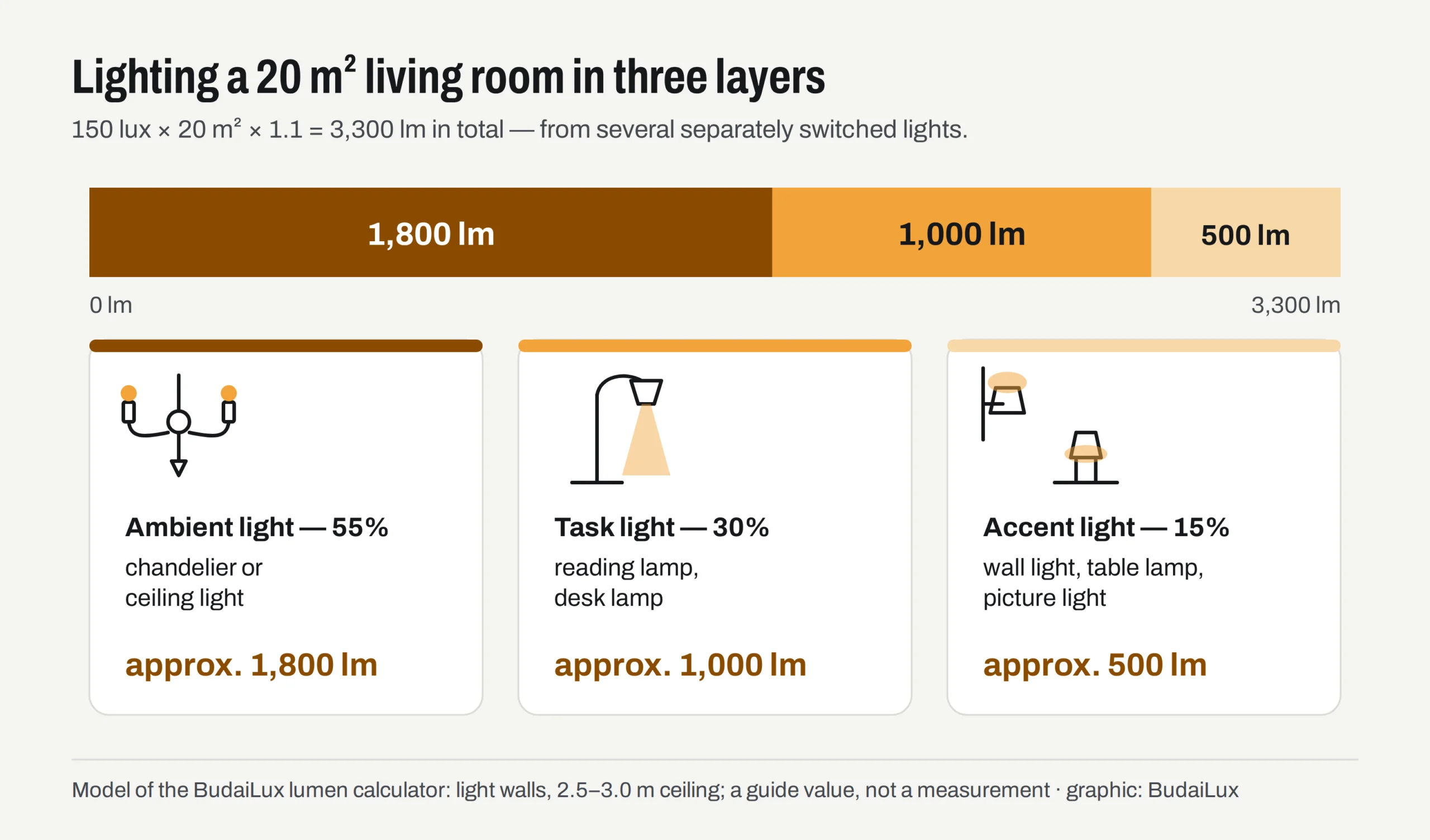
A 20 m² living room with light-coloured walls and a 2.5–3.0 metre ceiling needs a total luminous flux of roughly 3,300 lm. The calculation: an illuminance target of 150 lux × 20 m² × a ceiling factor of 1.1. There is no mandatory lighting standard for homes; 150 lux is a well-established design guide value for living rooms, and for reading you need a separate 300–500 lux at the armchair.
This total doesn’t come from a single light. Our lumen calculator splits it into three layers: ambient light gets roughly 55% of it, task light (reading lamp, desk) 30% and accent light (wall lights, picture lighting, table lamps) 15%. The chandelier is the ambient light, so in a 20 m² living room it is worth planning about 1,800 lm for it. The same layering works in the bathroom, where the task layer is the lighting around the mirror.
If the chandelier is going to be the living room’s only light, it has to provide the full 3,300 lm or so — but then it should be dimmable, because full light is too much in the evening. With dark wall finishes you need 20–30% more light, and if the room is regularly used by someone over 60, roughly one and a half times as much. The difference between lumens and lux is explained in our article on the numbers on a light bulb box, and the values room by room in our guide to how many lumens you need.
With a multi-arm chandelier, the luminous flux is the sum of its light sources. A six-arm E14 chandelier with six “40 W equivalent” candle bulbs gets roughly 6 × 470 = 2,820 lm, because the EU energy labelling regulation assigns 470 lm to this claim. The shades and diffusers absorb some of this, so the light that actually leaves the chandelier is less.
What light colour and dimming suit a living room chandelier?
A living room calls for warm white light of 2700–3000 K, with a colour rendering of at least Ra 80. Stick to one colour temperature within a space: if the chandelier is 2700 K, the floor lamp and the wall lights should be too. Our article on the colour temperature scale shows the difference between light colours in pictures.
A crystal chandelier’s sparkle comes from small, bright points of light. With clear candle-shaped or filament bulbs the crystals sparkle; with opal, milky-white bulbs the light is softer and the sparkle duller. Neither is good or bad — it’s just a different effect.
Dimming is almost an essential comfort on a living room chandelier: in the evening, the full luminous flux is too much. For this you need light sources marked as dimmable and a compatible dimmer; which dimmer works with what, and why an LED hums or flickers, is explained in our article on dimmable LEDs. A cheaper solution is a two-circuit chandelier with a double (two-gang) switch: you can switch on one group of bulbs or both.
With a chandelier that has integrated LEDs, check whether the light source can be replaced. Under the EU ecodesign regulation, the manufacturer must state whether the light source and the separate control gear can be replaced by the end user or by a qualified person without damaging the light; this information appears on the packaging, at least as a pictogram, and in the user instructions.
Can the ceiling hold the chandelier?
Two numbers need to be compared: the weight of the chandelier, given on the manufacturer’s data sheet or the box, and the load capacity of the fixing, given by the manufacturer of the wall plug, hook or mounting plate. The requirements for fixing luminaires are set out in HD 60364-5-559 (in Hungary: MSZ HD 60364-5-559; in the UK: BS 7671, section 559); in practice, the load capacity depends on the ceiling material and the fixing.
A manufacturer’s example shows how big the difference can be. The recommended load for the fischer DuoTec 10 toggle plug with its matching hook, in a single 12.5 mm plasterboard sheet with a 625 mm support spacing, is 0.20 kN — roughly 20 kg; in concrete, with the same hook, it is 0.30 kN, because there the bending of the hook becomes the weak point. According to the manufacturer, these values already include the necessary safety factor. So for a heavy crystal chandelier, it is the plug’s data sheet that decides, not its name.
Safety note. Connecting a chandelier to the mains is a job for a qualified electrician. Before mounting and wiring, the circuit breaker for the circuit has to be switched off and the wires checked with a two-pole voltage tester to make sure they are dead — a neon test screwdriver is not reliable for this. A heavy chandelier takes two people to mount: while it is being connected, its weight must not hang on the wires. If you don’t know what the hook is fixed into or how much load it can take, leave the fixing to the electrician as well. The steps are described in our article on wiring a ceiling light or chandelier.
What style of chandelier suits a living room?
Style is a matter of taste, but the shape also affects sizing and maintenance. A modern chandelier — ring-shaped, flat or geometric — usually comes with integrated LEDs and takes up little vertical space, so it also suits lower ceilings. A classic chandelier with arms and a crystal chandelier are taller and need more room, and their light sources can be replaced one by one.
The materials also shape the character of the light: an open chandelier with arms and no shades throws a lot of light onto the ceiling, while one with downward-facing shades lights the table and the floor instead. Measuring, materials and replacement of shades and lampshades are covered in our guide to lampshades and light shades.
Frequently asked questions
What size of chandelier does a 20 m² living room need?
A 4 × 5 metre, 20 m² living room suits a chandelier of about 70 cm in diameter; anything in the 65–80 cm range also works. The formula: (4 + 5) × 8 = 72 cm. In terms of light, the room needs about 3,300 lm, of which the chandelier should provide about 1,800 lm if there is also a floor lamp and accent lighting.
How high should a chandelier hang above a dining table?
The bottom of the light should be roughly 70–85 cm above the table top — measured from the table, not the floor. That way it doesn’t dazzle you when you are seated, and it doesn’t block your view of the person across the table. The diameter should be half to two-thirds of the table’s width: 45–60 cm over a 90 cm wide table.
What size of chandelier does a bedroom need?
The sizing is the same: length + width in metres, multiplied by 8. A 3.0 × 3.5 metre bedroom therefore suits a chandelier of about 50 cm. You need less light than in a living room — the lumen calculator uses 125 lux and a 2700 K light colour — and for reading you need a separate bedside lamp.
Is one chandelier enough for a living room?
In terms of luminous flux it can be; in everyday use, rarely. A single ceiling light gives even but flat light, and in the evening it is either too much or too little. It is better if the chandelier provides the ambient light, with a reading lamp and one or two accent lights beside it, switched separately.
What colour temperature should the bulbs in a living room chandelier be?
Warm white of 2700–3000 K, with a colour rendering of at least Ra 80. Neutral white at 4000 K looks harsh in a living room in the evening. The chandelier’s light colour should match the other lights in the room; otherwise the colours of the space fall apart.
Sources
- Commission Delegated Regulation (EU) 2019/2015 on the energy labelling of light sources, EUR-Lex — Annex V, Table 7: a claim of “equivalent to 40 W” corresponds to a luminous flux of 470 lm.
- Commission Regulation (EU) 2019/2020 laying down ecodesign requirements for light sources and separate control gears, EUR-Lex — Article 4: replaceability of the light source and the information to be given about it.
- fischer: DuoTec toggle plug — technical data and recommended loads (PDF, manufacturer’s catalogue page) — DuoTec 10 with fischer hook: 12.5 mm plasterboard 0.20 kN, concrete 0.30 kN.
- Hungarian Standards Institution (MSZT), standard record (in Hungarian): MSZ HD 60364-5-559:2013 — Low-voltage electrical installations. Part 5-559: Luminaires and lighting installations — the Hungarian edition of HD 60364-5-559.