A shade or lampshade is the easiest part of a light to replace — and the easiest to buy wrong. A few millimetres out on the fitter ring, and the new shade either won’t go onto the lamp holder at all or wobbles on it. And a fabric lampshade that is too narrow can end up close to the bulb, where heat starts to matter.
Below we go through what to measure before you buy and how, the different types of fitting, how much heat a shade can take, and what kind of light glass, fabric, metal and rattan give. For dimensions we rely on manufacturers’ data sheets and standards; where there is only a rule of thumb, we say so.
How do you measure a shade or lampshade?
You need four measurements: the top and bottom diameter, the vertical height and the size of the fitting — for a lampshade with a ring, the opening of the ring; for a glass shade, the diameter of the rim. Measure edge to edge, not along the sloping side. Whether the new one will fit is decided by the size of the fitting, not by the outside dimensions.
The outside dimensions are about proportions; the size of the fitting decides whether you can mount the new piece at all. So take the old shade or lampshade off and measure its supporting frame too, not just the visible part. You’ll need callipers for the ring and the rim; a tape measure is enough for the rest.
| What do you measure? | How? | What is it for? |
|---|---|---|
| Top diameter | Between two opposite points of the top rim, through the centre. | For the proportions; it is also where the upward light and the heat escape. |
| Bottom diameter | Between two opposite points of the bottom rim. | For the size of the pool of light below, and for a proportion that suits the base. |
| Height | Vertically, between the planes of the two rims. | It decides whether the shade hides the lamp holder and the bulb. |
| Slant length | On a tapered shade, along the side, from rim to rim. | For comparison only: if a shop gives this as the height, don’t confuse it with the vertical height. |
| Opening of the fitter ring | The inner diameter of the ring at the centre of the frame, measured with callipers. | It decides whether the lampshade fits onto an E27 or an E14 lamp holder. |
| Position of the ring | The vertical distance between the plane of the ring and the top rim. | It decides how high the shade sits relative to the bulb. |
| Rim (neck) of a glass shade | The outer diameter and height of the rim, measured with callipers. | This has to fit into the screw holder or under the ring of the lamp holder. |
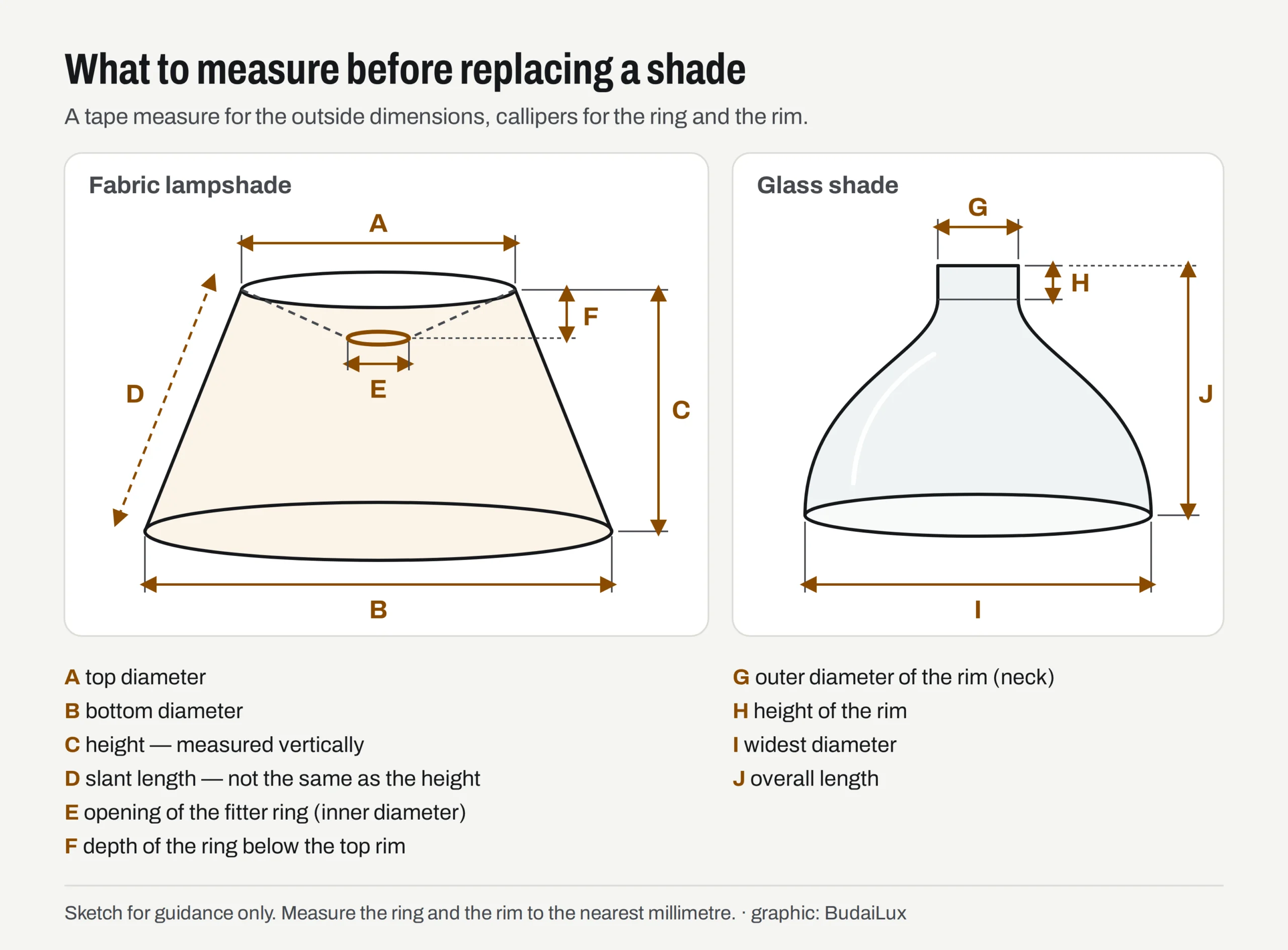
On a tapered lampshade — one shaped like a truncated cone — the length measured along the side is always greater than the vertical height. If you mix the two up, the new shade will be shorter than you expected, and the lamp holder may show below it.
What is the difference between a shade and a lampshade?
Everyday language doesn’t draw a sharp line, but in practice a lampshade is usually made of fabric, paper or thin plastic, is open at the top and bottom, and sits on a table or floor lamp. A shade — often called a light shade — is typically glass, plastic or metal, partly or fully encloses the light source, and is found on ceiling, pendant and wall lights.
The difference isn’t just a matter of names. A lampshade lets the light out freely upwards and downwards and filters it sideways; an enclosed shade spreads it in all directions, but it also keeps more of the heat in. On bathroom and outdoor lights, the shade, together with its seal, is part of the protection against water: replacing the shade there also affects the light’s IP rating. The details are in our article on IP ratings, and bathroom use is covered in our guide to lighting above the bathroom mirror.
Which lamp holder does a lampshade fit?
On most table and floor lamps, the lampshade goes directly onto the lamp holder. At the centre of the shade frame there is a ring: you slide it over the threaded sleeve of the lamp holder, and a shade holder ring screwed on top clamps it down. This only works on a lamp holder with a threaded sleeve; on a smooth-sleeved E27 lamp holder there is nothing to screw the ring onto. Our article on bulb bases helps you identify the lamp holder in your light.
The opening of the lampshade’s ring is right if it is larger than the threaded sleeve of the lamp holder but smaller than the outer diameter of the shade holder ring — otherwise either it won’t go on, or the ring won’t hold it down. The thread is standardised by EN 60399 (IEC 60399, Barrel thread for lampholders with shade holder ring), so a standard E27 ring fits a standard threaded E27 lamp holder, and likewise E14 on E14.
| Fitting | How does it hold? | What should you measure? | Where is it common? |
|---|---|---|---|
| Shade holder ring, E27 | The lampshade’s ring is clamped down by a ring screwed onto the lamp holder. | The inner diameter of the opening. In one manufacturer’s example, the outer diameter of the ring is 55–56 mm. | Table and floor lamps, pendant lights |
| Shade holder ring, E14 | The same, in a smaller size. | The inner diameter of the opening. In one manufacturer’s example, the outer diameter of the ring is 40–43 mm. | Smaller table lamps, wall sconces, chandelier arms |
| Harp and finial | The lampshade’s spider fitter sits on a metal harp fixed below the lamp holder, held at the top by a decorative screw-on finial. | The height of the harp and the hole in the spider fitter. | Mainly American-style table and floor lamps |
| Clip-on | The lampshade’s wire frame clips onto the bulb. | The shape and size of the bulb. | Small shades on chandelier arms, on candle bulbs |
| Glass shade holder with screws | The rim of the shade is held in the holder (gallery), typically by three thumb screws. | The outer diameter and height of the rim, and the inner diameter of the holder. | Ceiling and wall lights, pendant lights |
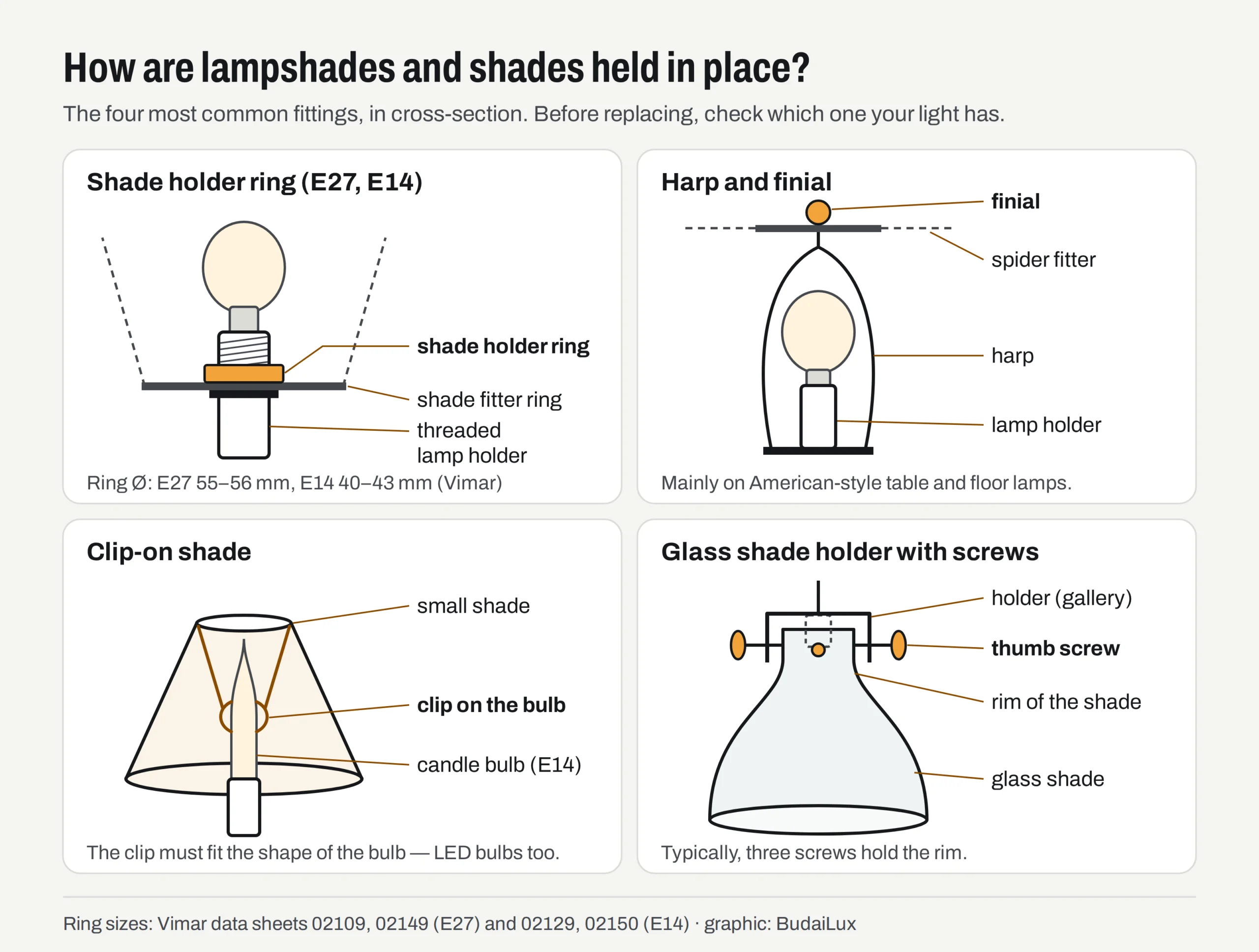
If you don’t know which fitting you have, take the old lampshade off. If there is a thread and a screw-on ring on the lamp holder, it’s a ring fitting; if a metal harp stands below the lamp holder, it’s a harp; if the lampshade’s wire frame sits on the bulb itself, it’s a clip-on. With a clip-on shade, check that the clip also holds well on the shape of the new LED bulb, because the glass of an LED bulb may differ in shape from the old one.
What size of lampshade suits a table or floor lamp?
There is no standard for this, only well-tried interior design rules of thumb. They are good for guidance; the final decision comes down to your sense of proportion and how the lamp is used. It is worth checking the proportion of lampshade to base on three counts:
- Height (rule of thumb): the lampshade should be roughly two-thirds the height of the base — the part of the lamp below the shade. A shade that is too tall looks heavy; one that is too short looks like a hat.
- Bottom diameter (rule of thumb): roughly equal to the height of the base, and in any case wider than the widest point of the base.
- Coverage: you shouldn’t be able to see the lamp holder or the bulb, whether standing or sitting. For this, the bottom rim of the shade has to reach below the lamp holder; if it doesn’t, you need a taller shade or a ring that sits lower.
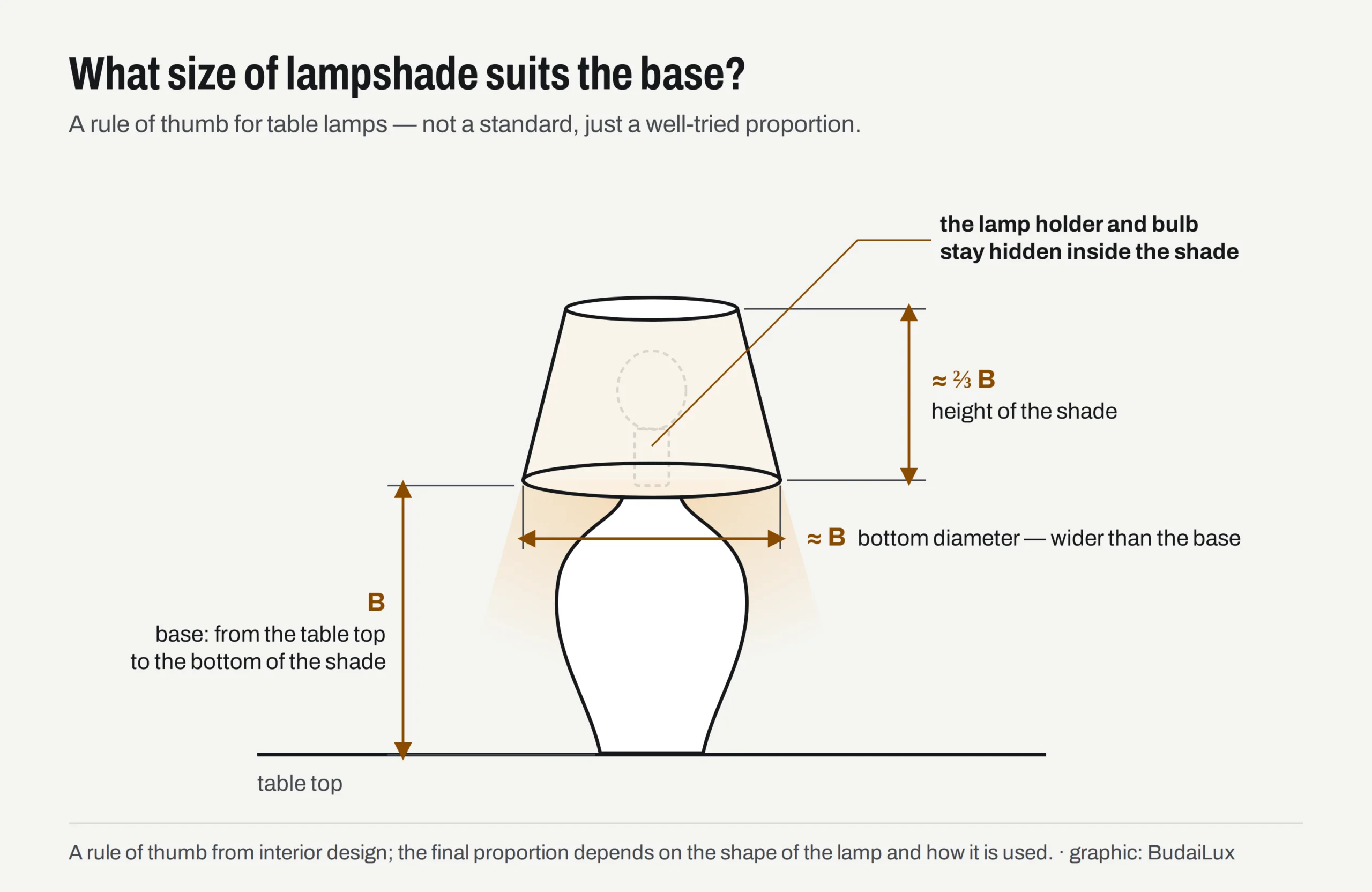
For a floor lamp the aim is the same: the bottom rim of the shade shouldn’t sit below the eye level of someone on the sofa, or they will look straight into the bulb. On chandeliers and multi-arm lights, the many small shades together make up the size of the light; there, the overall diameter has to suit the room, as our article on living room chandeliers shows.
How hot does a shade get, and which bulb can you use?
The luminaire — on its rating plate or near the lamp holder — states which type of light source can be used, and its maximum wattage. Manufacturers’ instructions are clear about this: one Hungarian lighting manufacturer’s instructions, for example, state that only light sources of the type and maximum wattage marked on the rating plate and around the lamp holders may be used.
Many lights carry another symbol too: the minimum distance to be kept from illuminated objects, in metres. Nothing should be closer to the light source than this — no curtain, no shelf, and not the material of the shade either.
The maximum wattage marked applies with the light’s original shade or lampshade, because the manufacturer designed the luminaire with it. If you fit a smaller shade, one that sits closer to the bulb, or one made of a different material, stay well below the marked value, and make sure the shade doesn’t touch the bulb anywhere.
With LED, the heat load drops to a fraction. According to the table in the EU energy labelling regulation, an LED bulb legitimately described as “equivalent to 60 W” gives about 806 lm, and at an average efficacy of 100 lm/W it draws roughly 8 W — between a seventh and an eighth of the old 60-watt bulb. Most of the power an LED draws also turns into heat, but it is 8 W, not 60 W. The base of the bulb can still get warm, so keep to the distance with LED too.
Safety note. Before replacing a shade or lampshade, switch the light off, unplug a plug-in lamp, and wait until the bulb and the shade have cooled down. If the replacement means taking down a ceiling or wall light, or touching the wiring, that is electrical installation work and a job for a qualified electrician: the circuit breaker has to be switched off first and the wires checked with a two-pole voltage tester to make sure they are dead — a neon test screwdriver is not reliable for this. The steps are described in our article on wiring a ceiling light or chandelier. Don’t keep using a melted or discoloured shade or a cracked lamp holder.
Bulb replacement helper
Watts measure consumption, not light. If you start from the wattage of the old bulb, it is easy to get it wrong — this table tells you the real equivalent based on luminous flux.
Conversion table
| Old bulb | Luminous flux | LED equivalent |
|---|---|---|
| 25 W | ~230 lm | 2–3 W |
| 40 W | ~430 lm | 4–6 W |
| 60 W | ~730 lm | 6–10 W |
| 75 W | ~950 lm | 8–12 W |
| 100 W | ~1,350 lm | 11–17 W |
| 150 W | ~2,200 lm | 17–28 W |
What to watch out for when swapping: the maximum wattage marked on the light fitting refers to incandescent bulbs — with LED it is practically never the limit. What does matter is the colour temperature (2,700–3,000 K at home), the colour rendering (CRI above 90), and whether it is dimmable if it goes on a dimmer. Not every LED is, and a non-dimmable LED on a dimmer flickers or fails.
What kind of light do glass, fabric, metal and rattan shades give?
The material of the shade decides whether the light is directed or diffused, whether you can see the bulb, and how much light reaches the ceiling and the walls. The same bulb appears as a sharp point of light in clear glass and as a soft glow in a fabric lampshade.
| Material | What is the light like? | What should you watch for? |
|---|---|---|
| Clear glass | Sparkling, with sharp shadows; the bulb is visible. | With a decorative or opal bulb it dazzles less; the filaments of a clear bulb are visible. |
| Opal or satin glass | Soft, even, diffused in all directions. | Absorbs a little more light than clear glass; washable and does not burn. |
| Fabric | Diffused; the light coming out at the top and bottom dominates, while sideways the colour of the fabric filters it. | A light-coloured lining lets out more light. Collects dust, and must not touch the bulb. |
| Paper | Soft, warm, translucent. | Sensitive to heat: use it with LED and plenty of clearance. |
| Metal | Comes out only through the openings, so it is directed; strong downwards, none sideways. | Gets warm; the colour of the inner surface sets the tone of the light. |
| Rattan, woven natural material | A patterned play of light and shadow on the walls and ceiling. | Flammable and collects dust: LED only, keeping to the marked distance. |
A coloured or beige fabric lampshade, or a metal shade with a gilded inside, also makes the light warmer in colour. If you want to know exactly what colour of light you will get, choose the kelvin value on the light source and judge the shade’s effect relative to that — light colours are covered in our article on the colour temperature scale.
What should you check when replacing a shade?
When replacing a shade, the safest choice is an original replacement shade; if there isn’t one, the measurements and the fitting decide. Work through it in this order:
- Find the light’s model number on the rating plate or the box. With it, you can ask the manufacturer or the distributor for an original replacement shade.
- Measure the fitting and the outside dimensions as in the table above, and photograph the old shade together with its holder.
- Check the lamp holder and the maximum wattage marked. If the new shade is smaller or more enclosed, choose a lower-wattage LED light source.
- On bathroom and outdoor lights, use only the shade and seal supplied by the manufacturer for that light, because the IP rating applies with the shade fitted.
- With a glass shade, tighten the screws by hand, and only moderately. An overtightened screw can crack the rim of the glass, and a loose shade can slip out.
- After replacing it, switch the light on and look at it from below and from the side to check that the shade sits straight, doesn’t wobble and doesn’t touch the bulb anywhere.
When replacing a glass shade, the rim is the critical dimension. Two shades can have the same shape and diameter, but if their necks differ by a few millimetres, one won’t even fit into the holder and the screws won’t reach the other.
How do you clean a shade or lampshade?
Before cleaning, switch the light off and wait until it has cooled down. Manufacturers’ instructions ask for two things: don’t use detergents or abrasive cleaners on the luminaire, and don’t let liquid get onto the electrical parts. So, wherever possible, take the shade off to clean it.
- Glass: wash it in lukewarm water with a little washing-up liquid, rinse it, and let it dry completely before refitting. Don’t put glass that is still warm into cold water: the sudden change in temperature can crack it.
- Fabric: use a soft brush, or the brush attachment of a vacuum cleaner on a low setting. Don’t soak a lampshade with a glued construction, because the glue may come apart.
- Paper: dry cleaning only, with a soft paintbrush or brush.
- Metal: use a dry or slightly damp soft cloth; abrasive cleaners scratch painted and coated surfaces.
- Rattan and woven materials: use a brush and a vacuum cleaner; don’t soak them, because moisture can warp them.
Frequently asked questions
Will an E27 lampshade fit an E14 lamp holder?
Not directly. The opening of an E27 lampshade’s ring is larger than the shade holder ring of an E14 lamp holder, so the ring won’t hold it down and the shade will slip off. For an E14 lamp holder, look for a lampshade with an E14 fitting.
What size of lampshade do I need for a table lamp?
As a rule of thumb, the lampshade should be roughly two-thirds the height of the base, and its bottom diameter about the height of the base — and wider than the widest point of the base. The most important thing is that the shade hides the lamp holder and the bulb.
Can I put an LED bulb in an old lamp under a fabric lampshade?
Yes, and it is the safer choice: it gives the same light from a fraction of the old bulb’s wattage, so the shade gets much less hot. Still keep to the lamp holder type and the maximum wattage marked on the luminaire, and make sure the shade doesn’t touch the bulb.
What is the difference between an opal and a clear glass shade?
Clear glass doesn’t diffuse the light: you can see the bulb, and the light is sparkling, with sharp shadows. Opal or satin glass diffuses it, so the light is softer and more even, but in return it absorbs a little more light. In a clear shade, use a decorative or opal bulb so that it doesn’t dazzle.
Where do I find the maximum permitted wattage on a light?
On the rating plate or near the lamp holder, for example as “max. 40 W”, together with the lamp holder type. The symbol for the minimum distance from illuminated objects, in metres, may be there too. If the marking is illegible, ask the manufacturer or the distributor, quoting the light’s model number.
Sources
- Hungarian Standards Institution (MSZT), standard record (in Hungarian): MSZ EN 60399:2005 — Barrel thread for lampholders with shade holder ring (IEC 60399:2004), amendment: MSZ EN 60399:2004/A1:2009 — the Hungarian edition of EN 60399.
- Vimar: manufacturer’s data sheets for shade holder rings — 02109, E27, Ø 55 mm (PDF), 02149, E27, Ø 56 mm (PDF), 02129, E14, Ø 43 mm (PDF), 02150, E14, Ø 40 mm (PDF).
- Rábalux: Instructions for use and care of a luminaire (multilingual, PDF) — only the light source type and wattage marked, the symbol for the distance from illuminated objects, cleaning.
- Commission Delegated Regulation (EU) 2019/2015 on the energy labelling of light sources, EUR-Lex — Annex V, Table 7: a claim of “equivalent to 60 W” corresponds to a luminous flux of 806 lm.